

It’s a tough time for a corporation seeking to build an AI data center anywhere in the United States. Resistance is stiffening. So it’s no wonder that Oakline at Mill Creek, the data center Verrus is proposing to build here in Salem, is trying to project a warm and fuzzy image.
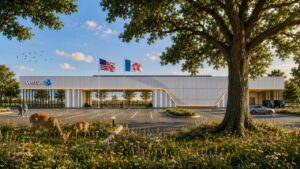
This is a tongue-in-cheek editing (by an AI, naturally) someone sent me of the Verrus mockup of what the data center would look like. The deer peacefully grazing on the grass in front of the building is a nice touch. How noisy could the data center be if deer enjoy it so much!
Unfortunately for Verrus, the plan for their Salem data center was revealed to the public just as support for data centers is cratering nationally. The title of a Politico story published today speaks volumes: “A growing political reckoning is coming for data centers, a Politico Poll shows.” Excerpt:
Americans’ attitudes toward data centers have grown increasingly sour and politically polarized in the past six months, a trend that signals trouble for the artificial intelligence industry and leaders of both parties, according to new results from The POLITICO Poll.
While growing opposition to the sprawling, server-packed data hubs is coming from both sides of the political aisle, it’s especially evident among Democrats, whose opposition to the projects has grown much faster than antagonism from Republicans, according to the July survey conducted by the independent polling organization Public First.
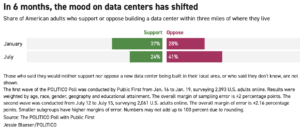
Since Salem leans decidedly Democratic, it isn’t surprising that the local data center is encountering fierce opposition even before the first opportunity to provide public comments at next Monday’s city council meeting.
Opposition stems from three intertwined sources: those who dislike AI in general, those who dislike the data centers required by AI, and those who dislike both AI and data centers.
Personally, I like AI, but I’ve got concerns about how the AI industry is evolving, including the reliance on giant data centers filled with thousands of high-end computer chips and associated servers, along with the infrastructure needed to power and cool all this technology. There’s a risk that advances in AI design could leave data centers like Oakline at Mill Creek in a position roughly analogous to how giant mainframe computers were largely made obsolete by personal computers than can fit on someone’s lap.
A few days ago the New York Times ran a story, “China’s latest AI breakthrough threatens America’s lead.”
The contest between China and the United States for supremacy in artificial intelligence escalated on Friday when the Chinese start-up Moonshot AI released a new A.I. model that appeared to narrow the lead held by well-funded American competitors.
Moonshot said that the model, Kimi K3, was the world’s largest open-source A.I. system, allowing anyone to use, modify and build on it freely. The company said that Kimi K3 performed as well as leading models from OpenAI and Anthropic at some key tasks.
The release coincided with an address by Xi Jinping, China’s leader, in which he outlined an ambitious vision for global A.I. development that cast China as the champion of an open approach to the technology.
“A.I. development should not be a solo performance by a single country but a symphony of international cooperation,” Mr. Xi said. China was “ready to work with all parties to seize the opportunities of A.I. development,” he said.
….The release of a free, open-source Chinese A.I. model that could rival the performance of costly, computing-intensive systems from Silicon Valley’s best-funded companies has reignited concerns over whether the industry’s enormous spending spree on data centers is justified.
Over the past 18 months, Chinese technology companies have released a steady stream of open-source A.I. models that approach the performance of their American rivals, while claiming to require fewer computing resources. That combination of strong performance and lower costs has made Chinese A.I. systems the preferred choice for many developers worldwide.
I’m also worried about an AI stock market bubble. Loads of money is pouring into any company associated with AI, because that’s the new investing buzzword. For those of us old enough to remember (I sure am), this has the feel of the 1980’s “dot com” frenzy where anything to do with the nascent internet was viewed as a can’t miss investment. Until the misses started and that sector crashed.
Another recent New York Times story, “A.I. is running on borrowed money,” says:
Data centers and the other infrastructure for A.I. involve staggering sums of money. These cascades of A.I.-driven cash have enriched diverse segments of the stock market, from semiconductor makers to engineering companies to utilities to energy producers. A.I. money is bolstering the entire U.S. economy, contributing perhaps 1.1 percent to the nation’s economic growth, JPMorgan Asset Management estimates.
…Few people outside the markets have paid attention to what goes on behind the financial curtain for artificial intelligence. These big companies are able to categorize the money as an investment — a capital expenditure — and not as an expense. So under current accounting rules, the bulk of the spending has not yet counted against their gaudy earnings. That is helping to propel the stock market to new heights under rosy assumptions that A.I. will transform the world, and that the companies behind it will be making money.
…These are early days.
I have no doubt that artificial intelligence is an important technology. Great fortunes are already being made. But I’m also certain that there will be many losers, as there were in two other episodes of mammoth infrastructure investments in budding technologies: the railroads in the 19th century and the various early internet companies of the dot-com era.
Well-run, diversified and deep-pocketed companies have a better chance of survival in epochs like these than those that take on inordinate risk with their capital investments. Even so, the future champions may not be any of the early giants.
A great winnowing is coming, and prudent investors will accept that they cannot know in advance who the winners and losers will be.
So the five billion dollar investment promised by Verrus for the 75 acre Salem data center may turn out to be a long-term success. Or, there’s a distinct possibility that those buildings will end up deserted after the AI bubble bursts. Which will make the neighborhood deer happy, along with all the opponents of the data center who can say to city officials who approved it, “We told you so.”
Discover more from Salem Political Snark
Subscribe to get the latest posts sent to your email.
The LLM-in-the-loop protocol with structured observation and action JSON is a clever abstraction for handling the unpredictable variety of comment forms. At APIVALE, when routing multi-model API workloads, we’ve seen similar benefits from a modular, state-machine-driven automation layer—especially the fill_many approach to reduce step count and avoid timeouts. Given the 0-5% survival rate, how do you calibrate the cost-per-link KPI without over-investing in verification?