

Trump thinks he’s a king. Thankfully, he’s just a lousy president. Kings can issue edicts that their subjects must obey. Presidents can’t. Especially when an edict is unconstitutional.
Like Trump’s newest fantasy — that through an executive order he issued in March 2026, the postal service won’t deliver a ballot unless the voter is on a list generated by the federal government of people who are eligible to vote in federal elections.
The Supreme Court likely will decide whether this scheme is constitutional. That should take about ten seconds. All the justices need to do is remind themselves of what Article 1, Section 4, Clause 1 of the United States Constitution says.
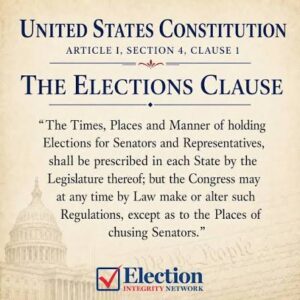
State legislatures decide the times, places, and manner of holding elections for Senators and Representatives. Such as the upcoming 2026 midterm election. And the 2028 general election. Congress can alter what state legislatures decide. The president can’t. There’s no mention in The Elections Clause of the president.
Case closed. Trump’s executive order is unconstitutional, since it markedly alters how states handle mail-in ballots, part of the “manner” of holding elections. So that leaves the question of why the executive order is a horrible idea.
As is typical of Trump, his executive order is a solution in search of a problem. The Brookings Institution reported:
We find an average total mail voting fraud percentage across the 2016, 2018, 2020, and 2022 general elections of only 0.000043%, or about four cases of mail voting fraud out of every 10 million mail votes.
Worse, the executive order is a poorly thought-out response to an essentially nonexistent problem. In April 2026 the Brennan Center shared “Analyzing the President’s Executive Order on Mail Voting.” Their overall take was:
If implemented, the executive order would inject chaos into our elections, block eligible American citizens from voting, undermine voter privacy, and expose election officials and others to criminal prosecution simply for doing their jobs.
Here’s key criticisms.
The latest executive order directs DHS to coordinate with the commissioner of the Social Security Administration to create a list of voting-age American citizens in each state….The federal government does not currently maintain a list of all U.S. citizens, let alone lists of citizens in each state, and there is no federal law that authorizes it to do so. Various federal privacy and information security laws have prevented the creation of such lists… Moreover, none of the datasets that the order lists are designed to determine whether a person “maintains a residence” in a given state.
************************************
The order requires DHS to share these lists with the states at least 60 days before each election but does not indicate what states are meant to do with them. The 60-day rule also means the lists would, by default, exclude individuals who are not 18 at the time of the list’s creation but reach voting age at the time of an election. It would also exclude individuals who gain U.S. citizenship during this period, as well as many Americans living abroad.
************************************
While the order directs DHS to allow individuals to review and correct their information on these lists, there are no provisions to ensure that affected individuals would be made aware of this process or that any corrections would be done in time to enable them to vote.
************************************
The order directs the U.S. attorney general to prioritize investigating and prosecuting state and local election officials who issue federal ballots to ineligible voters, without regard for criminal intent or whether those ineligible individuals actually cast the ballots. Because this directive immediately follows the order’s section establishing “state citizenship lists,” it appears to suggest that election officials who issue ballots to individuals not on the faulty lists created by DHS will be treated as criminals.
************************************
Similarly, the order directs the DOJ to prioritize investigating and prosecuting other individuals and entities involved in “the printing, production, shipment, or distribution of ballots” to ineligible individuals. This appears to sweep in election administration vendors, postal workers, and civic volunteers who help individuals submit their ballots. It is difficult to imagine how any of these potential targets would even know a voter’s eligibility, let alone have the criminal intent to help them vote while ineligible, suggesting that their liability would be based entirely on whether a voter was not on DHS’s state citizenship lists.
************************************
The order directs USPS to issue regulations specifying how states should design mail ballot envelopes. USPS does not have, and has never before claimed to have, any authority over state ballot design choices. Nor does it have the expertise to design ballots. The only election-related services it offers to states, apart from regular mail delivery, are voluntary expedited mailing and tracking services. The president likewise has no authority over ballot design or any other aspect of election rules, nor can he direct the actions of the Postal Service, which is an independent agency.
************************************
The order directs USPS to create a third set of lists for each state — “mail-in and absentee participation lists” — and to refuse to deliver ballots cast by anyone who isn’t on them. It’s entirely unclear how USPS would determine who should be on these lists. It seems that the order means for USPS to use DHS’s “state citizenship lists” to cull the mail voter lists that states provide, though that is left unsaid. What is clear is that it intends for USPS not to deliver the ballots of otherwise eligible voters who are not on the agency’s new “mail-in and absentee participation lists,” even though multiple federal laws prohibit USPS from selectively refusing to deliver mail.
************************************
Nothing in the order would require USPS to notify voters if they aren’t on the agency’s approved list and their mail ballot is therefore never delivered to a local election office. Without such notice, many voters would have no idea their vote was not counted. Even if USPS did provide notice, many affected individuals might not have the time or the means to correct the issue or switch to another voting method. For instance, elderly, disabled, and overseas Americans who rely on mail voting may face significant barriers to voting in person or through alternative means, especially on short notice.
Discover more from Salem Political Snark
Subscribe to get the latest posts sent to your email.