

It’s September. Time to start taking seriously projections for how the November 3 midterm election will turn out. My favorite prognosticator is Nate Silver, who runs the Silver Bulletin that I subscribe to, political junkie that I am.
Silver is analyzing every race for the House, Senate, and Governor, along with the probability of each party controlling the House and Senate. Naturally Silver’s model will be frequently updated between now and November 3, so what I’ve shared below is just a snapshot as of September 2.
This is a description of the basic methodology used by Silver’s FLIPR model: Forecast with Leading Indicators, Polls and (Expert) Ratings. I’m sharing the default Deluxe model numbers.
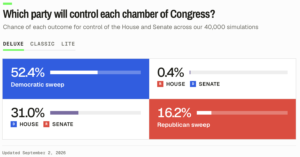
Here are today’s topline numbers for Senate and House control. They are typically based on 40,000 simulations and include a small amount of sampling error. FLIPR models House, Senate and gubernatorial elections jointly, meaning that we can calculate the probability of things like Republicans holding the Senate but losing the House.
Our default Deluxe model incorporates polls, fundamentals such as fundraising and incumbency, and expert race ratings from the Cook Political Report, Inside Elections and Sabato’s Crystal Ball. We also run Classic (polls and fundamentals) and Lite (just polls) versions of FLIPR; you can switch between these using the buttons in each chart.
Nationally, Silver has the House with a 83.4% chance of Democratic control. The average seats from the 40,000 simulations is 231 D and 204 R. So this fits with the usual assumption that Democrats have a high probability of retaking the House of Representatives.
Silver has the Senate with a 52.8% chance of Democratic control. Average seats is 51 D and 49 R. Basically a toss-up. Which is much better than the dismal assumption that Democrats had a very slim chance of a Senate majority not all that long ago.
This shows the probability of each party controlling the House and Senate. Most likely at 52.4% is a Democratic sweep of both chambers. Next most likely is Democrats controlling the House and Republicans controlling the Senate at 31.0%. Less likely is a Republican sweep at 16.2%. And the chance of Republicans controlling the House and Democrats the Senate is extremely slim, 0.4%.
Looking at Oregon, I’ve been wondering why, so far, there’s been little buzz about the six House seats up for election next November, along with a Senate race. Even the race for Governor has been pretty low key so far. The reason might be that Silver’s FLIPR model gives Republicans a low chance of success in each race other than eastern Oregon’s OR-2 House seat.
Senate: Merkley (D) has a 99.9% chance of defeating Smith (R).
House:
OR-1: Bonamici (D) has a 100.0% chance of defeating Kahl (R)
OR-2: Bentz (R) has a 99.8% chance of defeating Beck (D)
OR-3: Dexter (D) has a 100.0% chance of defeating Ayles (R)
OR-4: Hoyle (D) has a 99.7% chance of defeating DeSpain (R)
OR-5: Bynum has a 99.3% chance of defeating Adair (R) and Lehman (I)
OR-6: Salinas has a 99.8% chance of defeating Russ (R) and Faler (I)
Governor: Kotek (D) has a 94.5% chance of defeating Drazan (R)
Here’s some closely watched Senate races.
Texas: Talarico (D) has a 64.3% chance of defeating Paxton (R)
Michigan: El-Sayed (D) has a 68.3% chance of defeating Rogers (R)
Maine: Jackson (D) has a 66.0% chance of defeating Collins (R)
Ohio: Brown (D) has a 56.0% chance of defeating Husted (R)
Iowa: Hinson (R) has a 55.4% chance of defeating Turek (D)
Discover more from Salem Political Snark
Subscribe to get the latest posts sent to your email.