

I have no idea why any reasonable citizen of our country would want to be a member of Democratic Socialists of America. Take a look at their program. It isn’t a holdover from some bygone day. It was developed between April and June 2026, just a few months ago.
It’s full of crazy ideas. Like…
- end capitalism
- draft a new Constitution
- abolish the presidency and supreme court
- do away with the Defense Department
- create a democratic socialist republic
Unfortunately, the most extreme positions of the Democratic Socialists of America give Trump and other Republicans a broad brush to paint DSA as wacko lunatic communists. This is regrettable, because there’s a lot to like in the DSA agenda, such as commitment to universal health care, police/prison reform, support of a Green New Deal to fight climate change, strong support of unions.
While watching my recording of last Sunday’s Face the Nation program, I took this photo of one of the results of a recent poll about how Democratic voters feel toward socialism and capitalism.
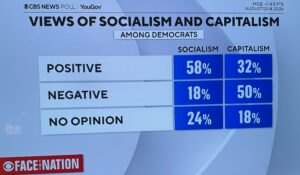
This surprised me. I suspect that the fondness of Democrats for socialism has less to do with what socialism actually is, and more to do with “democratic socialism” as it is practiced in Scandinavian countries like Sweden, Denmark, and Norway — which differs a lot from the more extreme view espoused by the Democratic Socialists of America.
Claude, the AI model, came up with this nifty summary of the difference between social democracy and socialism.
The terms get conflated a lot, but they refer to fundamentally different things regarding who owns the means of production.
Socialism
At its core, socialism is about collective or public ownership of the means of production (factories, land, capital, major industries) rather than private ownership. The idea is that if workers or the state/community own and control production, wealth and decision-making power get distributed more equitably than under capitalism, where owners of capital capture most of the gains from production.Key variants:
- State socialism: The government owns/controls major industries (historically the USSR, Maoist China, present-day Cuba).
- Market socialism: Worker cooperatives or state-owned enterprises operate within a market system.
- Democratic socialism: Socialism achieved and maintained through democratic institutions rather than revolution or authoritarian control (this is a political philosophy, not to be confused with “social democracy,” below — though the two overlap a lot in casual usage).
The throughline across all socialist variants is that they aim to fundamentally change who owns capital.
Social democracy
Social democracy accepts capitalism and private ownership of the means of production as the basic economic system, but uses heavy government intervention — taxation, regulation, and redistribution — to soften capitalism’s rough edges and ensure a robust welfare state.Under social democracy:
- Businesses are still privately owned and operate for profit.
- Markets still set prices, wages (with regulation), and allocate most resources.
- But high taxes fund universal healthcare, education, pensions, unemployment benefits, and other social programs, and strong labor regulations protect workers.
This is exactly the model in Denmark, Norway, and Sweden that we discussed — private companies like IKEA, Spotify, Novo Nordisk, and Equinor operate as normal profit-seeking capitalist enterprises. The “socialism” label often applied to these countries is actually a misnomer; economically they’re closer to regulated capitalism with a large welfare state than to socialism in the classical sense.
The key distinction, simplified
Socialism Social Democracy Ownership of production Public/collective Private Markets Reduced or replaced Preserved, regulated Goal Restructure ownership of capital Redistribute outcomes of capitalism Profit motive Diminished or eliminated Intact, taxed heavily
Socialism is a bad idea. Social Democracy is a good idea. Sadly, the Democratic Socialists of America have embraced core tenets of socialism, instead of sticking with the much more palatable tenets of social democracy.
The Scandinavian countries heavily tax people of all income levels, not just the rich. In exchange, citizens enjoy social benefits that we can only dream of here in the United States. Claude educated me about this also.
Scandinavian countries (Denmark, Norway, Sweden, sometimes including Finland and Iceland) run “social democratic” welfare states that differ from the US in several concrete ways:
Healthcare
Universal coverage funded through taxes, with care generally free or low-cost at the point of use. No link between employment and insurance, and no risk of medical bankruptcy.Education
Free tuition through university (Norway, Denmark, Finland; Sweden charges non-EU international students). Many also provide living stipends to university students, not just loans.Parental leave and childcare
Far more generous paid parental leave — often 12-18+ months combined between parents, at a large percentage of salary — plus heavily subsidized, high-quality childcare and preschool.Unemployment and labor protections
Stronger unemployment benefits (higher wage replacement, longer duration) and, in some cases, “flexicurity” systems (Denmark) that make it easier for employers to hire/fire but cushion workers with generous benefits and retraining.Paid time off
Legally mandated vacation (typically 5-6 weeks) and paid sick leave, standard across all these countries.Pensions and elder care
Universal public pension systems and subsidized elder care/nursing services.Income security net
Broader cash assistance, housing subsidies, and family allowances (child benefits paid to all parents regardless of income).How it’s funded
These benefits come with significantly higher taxes — not just on top earners, but often on middle-income workers too (VAT/sales taxes are also higher). It’s a trade-off: less take-home pay and higher consumption taxes in exchange for guaranteed services and a much thinner risk of falling into poverty from job loss, illness, or having a child.Trade-offs and counterpoints worth noting
— These countries are smaller and more culturally homogeneous, which some argue makes high-trust, high-tax systems easier to sustain politically than in a large, diverse country like the US.
— Nordic countries actually have quite market-friendly, deregulated business environments in other respects (e.g., easy to start a business, flexible labor markets in Denmark) — the “socialism” label is often considered a misnomer, since they’re market economies with a large welfare state layered on top, not centrally planned economies.
— Some economists point to trade-offs in innovation incentives, tax burden on the middle class, and slower income growth at the top of the distribution.
— The US system offers lower average tax burdens and, for many, higher potential upside (higher average wages in certain sectors, more capital formation), at the cost of a thinner safety net.
Democrats running for office in the November midterm election should stress that they favor moving the United States further in the direction of a social democracy like the Scandinavian countries, which are the happiest in the world, but not toward socialism.
Discover more from Salem Political Snark
Subscribe to get the latest posts sent to your email.