

Every legislative session in Oregon features some bad bills that somehow get passed. Then the only remedy is for the governor to veto a bad bill. That’s what needs to happen with HB 4177, which seriously weakens Oregon’s public meetings law — as I warned last month in “Really irritating that Oregon legislature may weaken public meetings law that Mayor Hoy violated.”
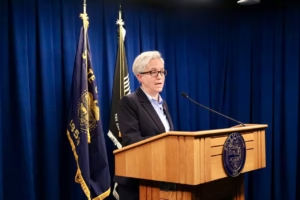
A March 11 Oregonian editorial calling for Governor Kotek to veto HB 4177 describes the worst part of the bill: a provision that allows a majority of the members of a public body to meet in secret to discuss information related to an upcoming decision by the public body, such as the Salem City Council.
Most everyone seems to agree that House Bill 4177, which aims to clarify public meetings law, will need fixes in a future legislative session. Lawmakers have recognized that the bill, which passed the Legislature last week and awaits the governor’s signature, may sacrifice too much of the public’s right to scrutinize government in favor of letting elected officials share information more efficiently.
And even the bill’s primary advocate and legislative sponsor disagree on just how broadly the bill expands elected officials’ ability to discuss issues in secret. League of Oregon Cities lobbyist Scott Winkels acknowledged critics’ concern that the bill would allow governing bodies to meet behind closed doors for a purely informational “work session” — a dramatic shift from today. Meanwhile, bill sponsor Rep. Nathan Sosa, D-Hillsboro, initially disputed that idea, before saying that it’s a question for ethics lawyers to address.
That’s an unconscionable amount of uncertainty to write into state law. Unfortunately, despite warnings from the ethics commission and news organizations that the bill takes a sledgehammer to the public meetings statute, few lawmakers were willing to vote “no” on HB 4177. Gov. Tina Kotek must step into the breach, prove her commitment to transparency and veto this legislation.
I urge you to do what I did today: use the governor’s ‘contact” page to send her a message urging that Kotek veto HB 4177. This is what I said in my message.
Governor Kotek, I strongly urger you to veto HB 4177, which weakens Oregon’s public meeting law. HB 4177 is so flawed, the sponsor of the bill has been quoted in news stories that almost pertaining the bill needs to be revised in the next legislative session, as it allows a quorum of a public body, such as a city council, to meet in private, with no public notice and no minutes, to discuss information about an issue that could later be deliberated and voted upon by the public body.
This strikes at the heart of the public meeting law, which requires open public discussion of issues before they are voted on. Allowing that discussion to take place behind closed doors is a fatal flaw of HB 4177, and why journalists are so opposed to this bill.
I filed a successful complaint against Salem Mayor Julie Hoy with the Oregon Government Ethics Commission. A commission investigation found that Hoy communicated individually with a quorum of the city council about whether the City Manager, Keith Stahley should resign. Hoy then lied to the council president, Linda Nishioka, falsely claiming that a majority of the city council wanted Stahley to resign. Nishioka shared that falsity with Stahley, and he did resign, wrongly believing that most city councilors wanted him gone. Actually, only Mayor Hoy wanted Stahley to resign.
Under the current public meeting law, Hoy engaged in an illegal “serial communication,” which bars a quorum of a public body such as a city council from discussing issues in private that could be deliberated and voted upon by the public body. HB 4177 would allow the previously prohibited action by Hoy — which means that all the public would see is a motion to take action on some issue, as the discussion of that issue would have taken place outside of public view.
HB 4177 is a solution in search of a problem. The Oregon Government Ethics Commission has issued guidance on what is, and what is not, allowed under the serial communications prohibition in the current public meeting law. Any confusion about this has arisen only because elected officials didn’t bother to study that guidance. I’ve followed this issue very closely, owing to the considerable time and effort I spent researching and filing my successful ethics complaint against Mayor Hoy.
My direct experience of the wisdom of the ban against serial communications leads me to urge you to veto HB 4177, which would allow elected officials to do the public’s business outside of the public eye, since all the public would see is “Do I hear a motion to…”, not any open discussion of the issue.
As I noted, the Oregon Government Ethics Commission has issued detailed guidance about what is, and what isn’t, allowed under the current public meetings law. Elected officials can still talk with constituents about an issue that will be decided by a public body. But a majority (quorum) of a public body can’t meet in secret to discuss information related to a decision. This portion of the guidance shows what might go into a decision.
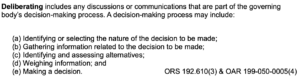
HB 4177 would allow a public body, such as the Salem City Council, to do each of the steps — a, b, c, d — other than actually making a decision. So all of the city councilors could get together at a restaurant to discuss information about an upcoming issue that will be voted on by the council, including identifying and assessing alternatives and weighing information.
Then, as I said in my message to Kotek, all that would need to be done in public at a city council meeting is for the chairperson to say, “Do I hear a motion to…” There would be no need for debate or discussion, because that would have already happened at the restaurant. After the motion is voted on, citizens would have no idea about what just happened, other than the outcome — since HB 4177 makes legal what used to be illegal: doing the public’s business behind closed doors.
Discover more from Salem Political Snark
Subscribe to get the latest posts sent to your email.