

I just checked.
Sadly, The Onion satirical news site doesn’t seem to have a story yet about Trump announcing today that he plans to charge ships passing through the Strait of Hormuz a 20% toll after the United States takes control of the Strait, because Trump is upset that Iran has been seeking to charge ships passing through the Strait of Hormuz a smaller toll when they had control of the Strait.
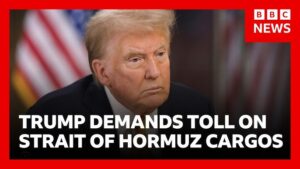
This absurdity would be funny if it wasn’t so deadly serious. After all, Trump’s Secretary of State, Marco Rubio, said just a few weeks ago:
No country is allowed to charge tolls or fees on an international waterway. That’s existing international law. That’s the way it is in international waterways all over the world, and that’s the way we expect it’ll be here.
Yet Trump wants to do just that. according to a New York Times story, “Trump Says Fighting With Iran Has Resumed as He Orders Blockade and Tolls.”
President Trump’s much-touted cease-fire with Iran effectively collapsed on Monday as he ordered the reinstatement of a naval blockade and announced that he will impose tolls on shipping in the Strait of Hormuz, despite his own administration’s position that such fees violate international law.
…“The Hormuz Strait is OPEN, and will remain OPEN, with or without Iran,” Mr. Trump wrote on social media. He added: “The U.S.A. will be, from this point forward, known as ‘THE GUARDIAN OF THE HORMUZ STRAIT,’ but as such, and as a matter of FAIRNESS, will be reimbursed, at the rate of 20% on all cargo shipped, for any and all costs necessary to do the job of providing safety and security to this very volatile section of the World.”
At a session with reporters later in the day, he justified the decision to charge shippers in much the same way he often talks about relationships with allies that he thinks should pay the United States for its support. “I want to be reimbursed because we’re protecting a very rich portion of the world,” he said, listing longtime U.S. friends like Saudi Arabia, Qatar, Bahrain and the United Arab Emirates. “And they will do very well.”
The decision to charge shippers flies in the face of the administration’s own stance when Iran threatened to do the same. Even in recent weeks, Mr. Trump’s team has insisted that charging for safe passage in the strait was intolerable. “No country is allowed to charge tolls or fees on an international waterway,” Secretary of State Marco Rubio said last month. “That is a normal that we will never be able to accept,” he said several weeks before that.
Since it is well known that Trump Always Chickens Out (TACO), it’s doubtful that the legally dubious 20% toll will ever actually be imposed. But if somehow it was, the consequences would be disastrous — like just about everything else Trump does. So says Google AI when I asked it about the reaction to the 20% toll proposal.
Shipping companies and industry officials have reacted with alarm and confusion, warning that the proposed 20% levy would violate international law. Operators are highly concerned about how this toll—meant to pay the U.S. Navy for guarding the strait—would impact operational costs and vessel safety. [1, 2]Industry-Wide Concerns:
- Legality & Precedent: Maritime officials and the UN’s shipping agency, the International Maritime Organization (IMO), strongly reject the tolls, stating there is no legal basis to charge mandatory fees for transit through straits used for international navigation. [1]
- Security Guarantees: Industry representatives have questioned how a U.S. toll will tangibly guarantee safer passage through the volatile waterway. [1]
- Surging Costs: Because approximately 20% of the world’s oil and natural gas supplies pass through the strait, companies warn that such a high toll will severely increase maritime insurance premiums and global freight costs, resulting in immediate spikes in crude oil prices. [1, 2, 3, 4, 5]
- Traffic Disruption: Amid ongoing hostilities, daily commercial ship transits through the strait have already collapsed, with companies reluctant to send vessels through the contested corridor. [1, 2]
For the latest operational advisories and updates regarding regional maritime security, monitor the International Maritime Organization or track vessel transit reports via MarineTraffic. [1]
Discover more from Salem Political Snark
Subscribe to get the latest posts sent to your email.