

When I learned today that the City of Salem had issued a public statement about a decision that Betsy Vega was qualified to serve as the Ward 6 city councilor despite a challenge by Paige Barton, the campaign manager for incumbent councilor Mai Vang, who Vega defeated, I was surprised.

After all, Barton had presented evidence that Vega (photo above) hadn’t lived in Ward 6 for the twelve months prior to the election — regardless of whether “election” means the May 19, 2026 primary election at which Vega got over 50% of the votes, or the November 3, 2026 general election where Vega will be the only candidate on the Ward 6 ballot due to meeting that 50% +1 threshold, virtually guaranteeing that she will be the general election winner (write in’s are a remote possibility).
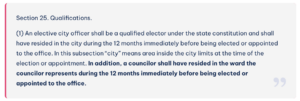
Here’s what the Salem City Charter says about the qualifications to be a city councilor, as I shared in a June 3, 2026 post, “Salem city officials are refusing to enforce the city’s own requirement to be a city councilor.” I boldfaced the pertinent sentence about a residency requirement.
City officials changed their mind about not considering Barton’s complaint, hiring a Eugene attorney to provide an opinion about whether Vega qualified to be a city councilor. After reading his opinion, I’m not impressed with his work, not at all. Here it is.
Memo _ re Nomination Eligibility 070626
The opinion by attorney Truman Stone does not accurately consider the clear City Charter language shown above. Note that the City Charter says “a councilor shall have resided in the ward the councilor represents during the 12 months immediately before being elected or appointed to the office.”
Now, I had thought that the election date was May 19, as that was when Vega defeated Vang. But the Certificate of Nomination issued by the City of Salem refers to the November 3, 2026 general election. Here it is:
Certificate of Nomination Decision Ward 6 – Public Statement 2026 07 06
But that doesn’t matter because Stone says in his opinion that Vega lived outside of Ward 6 from November 17, 2025 to March 4, 2026. So obviously Vega didn’t reside in Ward 6 during the 12 months either prior to November 3, 2026 or the 12 months prior to May 19, 2026. So how the heck could Stone conclude that Vega is qualified to be a Ward 6 city councilor?
Only through some tortured logic, as shown in this screenshot from Stone’s opinion.
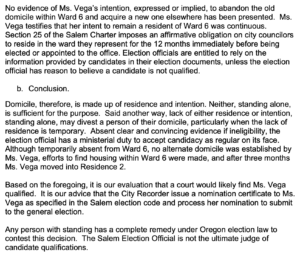
Stone starts off by speaking of domicile, which has a connotation in the law of being a permanent home or place a person has a substantial connection with. But then he shifts to speaking of Vega’s continuous intent to remain a resident of Ward 6. Well, fine, I have an intent to win a million dollars in the lottery. But so far that hasn’t happened, just as Vega’s intent to be a resident of Ward 6 didn’t happen between November 17, 2025 and March 4, 2026.
He then cites the requirement in the City Charter for city councilors to reside in the ward they represent for the 12 months immediately before being elected or appointed to the office. Great. I expected that Stone then would address the question of how Vega could meet this requirement when she hadn’t lived in Ward 6 for the 12 months prior to November 3, 2026 (or May 19, 2026).
Continuously for those 12 months. Not intermittently. Continuously. Stone says this on page 14 of his opinion.

Problem is, Stone fails to mention that Section 25 of the Salem Charter says that a city councilor must have resided in the ward for those 12 months. It doesn’t say presence. It doesn’t say domicile. It says resided. As in, you know, someone’s residence.
Then in his Conclusion, Stone bizarrely speaks again of domicile as being made up of residence and intention. Fine, but irrelevant. Because again, the City Charter speaks of resided, not domiciled. And there is no doubt that Vega didn’t reside continuously in Ward 6 for the 12 months prior to the election.
This really is a poorly written opinion. Stone says that lack of either residence or intention may divest a person of their domicile. Either. Well, Vega did not have a residence in Ward 6 for the 12 months in question; she just had an intention to live in Ward 6 for the 12 months. So seemingly this should lead Stone to conclude that Vega did not have a domicile in Ward 6, since she lacked a residence for the entire 12 months.
Then, truly bizarrely, Stone shifts away from speaking about Vega having a domicile in Ward 6, which apparently she didn’t, given her lack of a residence, into saying that no alternative domicile outside of Ward 6 was established by Vega. Again, irrelevant for the purpose of the City Charter requiring that a city councilor reside in their ward for 12 months prior to the election.
The City Charter doesn’t say that a city councilor can’t have a domicile outside of their ward. It says that a councilor has to have resided in their ward. Yet somehow Stone argues that because Vega didn’t choose to live permanently outside of Ward 6, this shows she is qualified to be a Ward 6 city councilor.
Wrong. Vega isn’t qualified, because she didn’t reside in Ward 6 for 12 months prior to the election. I hope Paige Barton and Mai Vang appeal the atrocious decision by the City of Salem to accept Stone’s poorly thought-out and legally dubious opinion.
Discover more from Salem Political Snark
Subscribe to get the latest posts sent to your email.
I’m concerned that the opinion from Jill Gibson points out that the city statute does not use the word “continuous” regarding the residency requirement. Much of the argument depends upon this assumed requirement.
Pete, in a previous post I shared what I learned from Google AI when I asked it about this legal question, since the city charter says “during” the 12 months prior to the election. Response was:
*********************************
In legal contexts, the word “during” generally means “throughout the entire course or duration of” when applied to candidate residency requirements.
In the phrase “must live in the city during the 12 months prior to the election,” courts almost universally interpret “during” to mean a continuous, unbroken physical and legal domicile for the entire 365-day period leading up to the election date. It does not mean “at some point within” those 12 months.
Key Legal Elements of This Definition
Continuous vs. Permissive Time: While standard dictionaries allow “during” to mean an isolated event inside a window (e.g., “it rained during the night”), election laws reject this. To satisfy candidate eligibility, the residency must span from day 1 to day 365 of that look-back period.
The Look-Back Timeline: The phrase “12 months prior to the election” sets a rolling timeline backward from election day. For example, if the election is on November 3, 2026, the candidate must have established and maintained city residency no later than November 3, 2025.
Legal “Domicile” vs. Mere Presence: Courts evaluate “living” in a city based on domicile (the permanent home to which you always intend to return) rather than absolute physical presence.
Allowed: Temporary absences (like going on a two-week vacation or traveling for business) do not break the “during” requirement.
Not Allowed: Moving your primary residence out of the city, changing your voter registration to another municipality, or renting an apartment in the city just a few months before the election will disqualify you.