

We’re all familiar with bureaucracies behaving badly. But I expected more from officials at the City of Salem when it comes to enforcing their own requirement for serving as a city councilor, because they’re refusing to make sure that Betsy Vega meets the residency requirement for serving as the Ward 6 city councilor.
There it is, on the City of Salem web site, on a page titled Elections – Run for Elected City Office. I’ll attach a screenshot.
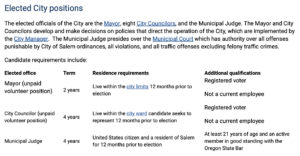
The residence requirement for becoming a city councilor is “Live within the city ward candidate seeks to represent 12 months prior to election.” This seems perfectly clear to me: someone who won an election for a city council seat in the May 19, 2026 election needs to have lived in the ward they will represent for 12 months prior to May 19, 2026. Meaning, from May 19, 2025 to May 19, 2026.
The city charter says the same thing, not surprisingly, since the city charter serves as the “constitution” for the City of Salem. I’ve boldfaced the pertinent sentence. I’ll share a PDF file of the city charter. [Note: I’ve added some updates at the end of this post. One concerns the legal definition of “during” as used in the boldfaced sentence below. Legally, “during” means continuously for the period in question. It doesn’t mean at some point in the period, as in everyday usage such as It rained during the night.]
cityofsalemcharter
Section 25. Qualifications.
(1) An elective city officer shall be a qualified elector under the state constitution and shall have resided in the city during the 12 months immediately before being elected or appointed to the office. In this subsection “city” means area inside the city limits at the time of the election or appointment. In addition, a councilor shall have resided in the ward the councilor represents during the 12 months immediately before being elected or appointed to the office.
Almost always there’s no controversy about whether someone elected to be a city councilor has resided in their ward for a year prior to the election. But in the case of Betsy Vega, who currently is leading incumbent Mai Vang by only 38 votes, a complaint has been filed by Vang’s campaign manager alleging that evidence suggests Vega may not have met the residency requirement to be the Ward 6 councilor.
A May 28 story in the Salem Reporter by Joe Siess, “Vega’s Ward 6 residency questioned as Salem city council race remains unsettled,” said:
A submission to the city, from Vang’s campaign manager, questioned whether Vega lived in Ward 6 at the time she filed for office and didn’t notify authorities as required when she moved last fall.
Vega didn’t respond directly to questions from Salem Reporter about her residence or share documentation establishing where her home is. Under the city charter, Vega must have resided in the city ward for one year before her filing to run.
City and state officials said Thursday it wasn’t clear what might happen if Vega doesn’t meet residency requirements. They couldn’t address whether one consequence would be disqualifying her from office.
I believe the Salem Reporter is incorrect when saying “Under the city charter, Vega must have resided in the city ward for one year before her filing to run.” As noted above, the city charter says that a councilor must have resided in the ward for 12 months immediately before being elected or appointed to the office.
Now, one would expect that city officials would take steps to make sure that Vega lived in Ward 6 for a full year prior to being elected (assuming her lead holds up), since this is a requirement to be a city councilor under the city charter and according to the City of Salem web site.
Unfortunately, that expectation isn’t being met. A June 2 story in the Salem Reporter by Joe Siess, “City punts on challenge to Betsy Vega’s election qualifications,” says:
Salem city officials are passing on settling allegations that attempt to disqualify Betsy Vega as a candidate for Salem City Council.
Salem City Attorney Dan Atchison said in an email on Monday, June 1, that the city’s decision finding that Vega was qualified to run for the northeast Salem seat “is final.”
Unbelievable. City Attorney Atchison appears to be unaware that the residency requirement for newly elected councilors in the city charter doesn’t refer to a candidate being qualified to run for a seat on the city council, but to a candidate residing in the ward for twelve months prior to the election.
Of course, this is the same Dan Atchison who didn’t understand Oregon’s public meetings law when he told Mayor Julie Hoy that she could talk privately with the members of the city council about the city manager’s employment status. That bad legal advice led to Hoy being found guilty of public meetings law infractions by the Oregon Government Ethics Commission.
It would be so simple for city officials to ask Betsy Vega to provide proof that she has satisfied the residency requirement to be a Ward 6 city councilor. It would be even simpler if Betsy Vega provided this proof herself and made it public. The fact that Vega hasn’t done this is suspicious. If she has nothing to hide, why is she hiding information about where she lived from May 19, 2025 to May 19, 2026?
Current members of the Salem City Council should demand of City Manager Krishna Namburi that she order city staff to make sure that Betsy Vega meets the residency requirement for councilors in the city charter. It’s bizarre that this is even needed, since it seems obvious that city officials should take seriously that city charter residency requirement.
But so far they’re not. Which I find really irritating.
Local government should be more responsive than state and federal government. Yet at the moment city officials have responded with a big yawn to the allegations that Betsy Vega may not have lived in Ward 6 for the year prior to her (apparent) election. Why have a web page with a section about the requirements to be a city councilor if city officials aren’t going to enforce those requirements?
If you also feel that Betsy Vega’s Ward 6 residency from May 19, 2025 to May 19, 2026 needs to be confirmed by city staff before she assumes her councilor position, contact City Manager Namburi: 503-588-6255 manager@cityofsalem.net
To contact the entire City Council:
citycouncil@cityofsalem.net
UPDATE: Paige Barton has shared a link to her written challenge to Betsy Vega’s candidacy in a comment to my post on Facebook’s Salem City Council Forum page. The challenge can be read here.
FURTHER UPDATE: Someone on Facebook raised the question of what “during” means in the context of what the city charter says: “In addition, a councilor shall have resided in the ward the councilor represents during the 12 months immediately before being elected or appointed to the office.” Does this mean living in the ward at some time during the 12 months, or continuously during the 12 months? I asked Google AI this question: what is the legal definition of “during,” as in “must live in the city during the 12 months prior to the election” The AI response included this:
In legal contexts, the word “during” generally means “throughout the entire course or duration of” when applied to candidate residency requirements.In the phrase “must live in the city during the 12 months prior to the election,” courts almost universally interpret “during” to mean a continuous, unbroken physical and legal domicile for the entire 365-day period leading up to the election date. It does not mean “at some point within” those 12 months.Key Legal Elements of This Definition
-
Continuous vs. Permissive Time: While standard dictionaries allow “during” to mean an isolated event inside a window (e.g., “it rained during the night”), election laws reject this. To satisfy candidate eligibility, the residency must span from day 1 to day 365 of that look-back period.
-
The Look-Back Timeline: The phrase “12 months prior to the election” sets a rolling timeline backward from election day. For example, if the election is on November 3, 2026, the candidate must have established and maintained city residency no later than November 3, 2025.
-
Legal “Domicile” vs. Mere Presence: Courts evaluate “living” in a city based on domicile (the permanent home to which you always intend to return) rather than absolute physical presence.
-
Allowed: Temporary absences (like going on a two-week vacation or traveling for business) do not break the “during” requirement.
-
Not Allowed: Moving your primary residence out of the city, changing your voter registration to another municipality, or renting an apartment in the city just a few months before the election will disqualify you.
-
Discover more from Salem Political Snark
Subscribe to get the latest posts sent to your email.