

Whether or not you favor Trump’s war against Iran, I highly recommend that you read a terrific March 26 article by Narges Bajoghli in Foreign Affairs, “Iran’s Long Game.”
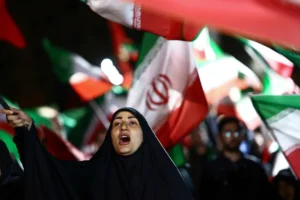
I liked it so much, after being able to read it as a guest, I just subscribed to Foreign Affairs — so that gift link should enable you to read it also. In case the link doesn’t work, here’s a PDF link of the article.
Iran’s Long Game | Foreign Affairs
Bajoghli has some solid credentials. She is an anthropologist and Associate Professor of Middle East Studies at the Johns Hopkins University School of Advanced International Studies.
In other words, she’s exactly the sort of expert on Iran and the Middle East that the Trump administration should have been relying on in preparing for war with Iran.
But since “expert” is a dirty word to Trump, who believes that he knows more than anyone else about every subject, and makes important decisions on the basis of how he feels at any particular moment, Bajoghli’s knowledgeable analysis of Iran’s capabilities would elicit a yawn from Trump.
Not from me, though. I found “Iran’s Long Game” to be the best explanation I’ve come across of why Iran is acting the way it is after being attacked by the United States and Israel.
Just because the Trump administration is floundering around, unable to settle either on a cogent reason for attacking Iran or a strategy to achieve the incoherent reasons they’ve put forward, doesn’t mean that Iran is similarly making stuff up as it goes along.
Quite the opposite, according to Bajoghli. Here’s excerpts from her article to whet your appetite for reading the whole thing.
Judging by the metrics of conventional conflict, Iran is not faring well against the United States and Israel. Its adversaries are destroying crucial targets in Iran, killing its commanders and degrading its military assets. But these are the wrong measures for assessing Iran’s position in the war.
The right measure is not even an assessment of whether Iran is absorbing punishment well—which it is. The question that will matter when the fighting ends is whether Tehran is achieving its strategic objectives. And on that count, Iran is winning.
This outcome is not accidental. Tehran has been preparing for this war for nearly four decades, since the new revolutionary government faced its first major military test in the Iran-Iraq War, which lasted from 1980 to 1988. And it is now executing a strategy that has managed to neutralize key U.S. and Israeli air defense batteries, severely damage U.S. military bases in the Persian Gulf, inflict substantial economic pain, and drive a wedge between the United States and its Gulf allies.
The Iranian regime, in other words, is not just surviving the U.S. and Israeli bombardment. The serious economic and political problems it is creating for its adversaries are, on a strategic level, giving Iran the upper hand.
…By the time the current war began, Iran had spent 35 years learning how to fight—and how to survive—against far more powerful adversaries. Those lessons are visible in Iran’s conduct today. The same decentralized logistics networks that Iran built to move fighters and materiel through Iraq and Syria are now being used to maintain supply chains under bombardment.
The same doctrinal flexibility that made Iranian-backed forces effective against U.S. forces in Iraq—their ability to absorb strikes, disperse, and reconstitute—is what has allowed the IRGC [Islamic Revolutionary Guard Corps] to keep functioning despite the assassination of senior commanders. Decades of preparation have served their purpose.
…The core component of this campaign involves the Strait of Hormuz, the chokepoint through which roughly one-fifth of the world’s oil and one-third of its fertilizer travel. Iran cannot fully close the waterway, but it does not need to. The credible threat of disruption is sufficient to rattle energy markets, raise shipping insurance costs, and force the United States to devote enormous military resources to the defensive mission of keeping trade lanes open—resources that could otherwise be used for offensive purposes.
…The Gulf states are not pro-Iranian. They are frightened of Iran and angry about its targeting of their economic assets and infrastructure. But they are also, for the first time in a generation, seriously questioning the value of their alignment with Washington. That doubt is precisely what Iran has been working toward.
A Gulf that no longer fully trusts Washington’s security guarantees is a Gulf less willing to host American bases, share intelligence, or finance U.S. military operations in the region. Iran’s long-term security depends not on defeating the United States militarily but on making the cost of the U.S. presence in the Gulf too politically expensive for its Arab hosts to sustain.
…The United States and Israel, meanwhile, are scoring tactical wins but struggling to realize the strategic goals of dismantling Iran’s military capacity to threaten the regional order and—as some factions in both governments still hope to do—forcing regime change. They have relied heavily on targeted killings to accomplish their goals, operating under the expectation that eliminating Iranian political leaders and IRGC commanders will degrade Iranian capabilities and deter Iranian action. The theory has not survived contact with reality.
…The decapitation campaign has also created a problem for the United States that Washington appears not to have anticipated: the Iranian commanders who have replaced those killed are, in many respects, more dangerous than their predecessors. They are younger. They fought Americans in Iraq. They fought Israelis in Lebanon and Syria alongside Hezbollah.
They believe—with considerable justification—that they helped defeat the most powerful militaries on earth in those theaters. They do not share the caution of the older generation of leaders, who remembered the catastrophic human costs of the Iran-Iraq War. And they face the institutional pressure that new leaders everywhere face: the need to prove themselves.
…Iran’s strategic doctrine has a phrase at its center: survive and exhaust. The goal is not to defeat the United States or Israel in any conventional sense. It is to show them both that the cost of confronting Iran is militarily, economically, and politically unsustainable. Tehran’s job is to survive punishment long enough, and to inflict enough damage in return, that U.S. and Israeli will for continued conflict collapses.
This strategy is working for now. Iran is absorbing strikes and continuing to function. Its military command has decentralized, and a new generation of commanders is even more willing than the old one to fight. Its economic campaign is threatening the Gulf order that Washington spent decades building. The wedge between the United States and its Gulf partners is widening, even as those partners reluctantly consider joining Washington in the war.
If these trends continue to move in Tehran’s favor, the war could end with the Islamic Republic battered but intact while the U.S.-Gulf alliance fractures, threatening to limit the United States’ regional power projection for years to come. Iran would emerge weakened in its conventional capabilities but stronger in the one currency that has always mattered most to Tehran: the demonstrated ability to defend its sovereignty against the most powerful militaries in the world.
The United States and Israel, with their overwhelming firepower, may be winning the battles. Iran, with 35 years of preparation and a strategy calibrated to outlast rather than outgun, may be winning the war.
Discover more from Salem Political Snark
Subscribe to get the latest posts sent to your email.