

The past isn’t the present. 2016 isn’t 2026. Donald Trump first running for president isn’t Donald Trump saying “pretend I’m on the ballot” in this year’s midterm election.
So naturally while I remember how good I felt watching the beginning of the 2016 election returns, and how crappy I felt when it was clear Hillary Clinton had lost, I’m not going to let this interfere with my optimism about what’s going to happen on November 3, 2026.
Because there’s solid evidence that the midterm election is going to make us Democrats happy and Republicans sad.
Here’s the final charts I’m going to share about how Nate Silver’s FLIPR (Forecast with Leading Indicators, Polls and (Expert) Ratings) model predicts the election will turn out. My previous blog post about Silver’s prognostication was October 20. What I’ve shared below is the Silver Bulletin update as of two hours ago. It includes a bunch of New York Times/Sienna polls favorable to Democrats that were released today.
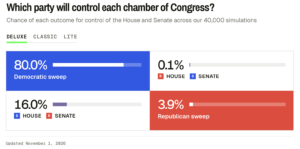
Silver gives Democrats a 80.0% chance of controlling both the House and Senate. This is up from 76.3% on October 20, so things are moving in the Democratic direction.
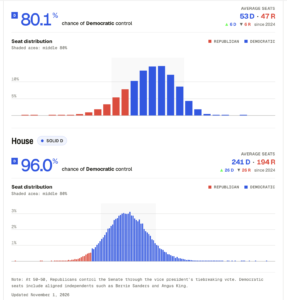
These charts show the model simulations for the Senate and House. The shaded area (hard to see unless you look closely) is the middle 80% of the expected outcomes, which unsurprisingly favor Democratic control much more than Republican control, especially in the House.
The Senate average is 53 Democratic seats and 47 Republican seats. That’s an exact flip from the current 53 Republican seats and 47 Democratic seats. The Democratic number includes two Independents who caucus with Democrats. So Silver is predicting a Democratic pickup of six Senate seats.
The House average is 241 Democratic seats and 194 Republican seats. Currently Democrats hold 214 seats, Republicans 218 seats, with one Independent and two seats vacant. So Silver is predicting a Democratic pickup of 27 House seats.
Today political pundits were buzzing about the unexpected endorsement of the Republican Senate candidate in Michigan, Mike Rogers, by Haley Stevens, a Democratic congresswoman in that state who narrowly lost to Abdul El-Sayed in the Democratic primary. This is a weird move by Stevens, given that as late as last night Stevens was telling people that she was going to endorse El-Sayed at a campaign rally today.
In an email to his subscribers (I”m one) Silver addressed the impact Stevens’ switch to endorsing Rogers might have on the Michigan Senate race. Basically Silver’s pleasingly geeky analysis was that this probably wouldn’t affect the outcome much. He reasoned that at most, assume 3% of voters are affected by Stevens’ endorsement of Rogers rather than El-Sayed.
But not all of the 3% will be more inclined to vote for Rogers. So he assumes one-third, or 1% of Michigan voters, will be irritated by a Democratic congresswoman endorsing the Republican candidate just before the election. So now they will be more likely to vote for El-Sayed. That means just a 1% bump in Rogers’ vote share (3% minus 1% leaves 2% for Rogers and 1% for El-Sayed).
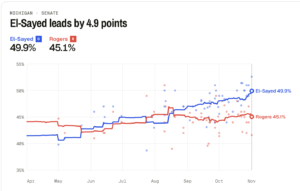
Here’s Silvers’ Michigan Senate vote share forecast. Since El-Sayed is leading by 4.9 points, losing 1% leaves him with a 3.9 point lead. Of course, this is just an estimate based on polls. Silver gives more weight to recent polls and higher quality pollsters. Today’s New York Times/Sienna poll conducted between October 27 and November 1 shows El-Sayed leading Rogers by 11 points, 53-42. As shown below, El-Sayed has been trending steadily upward while Rogers has been holding steady the past few months as undecided voters tilt toward El-Sayed.
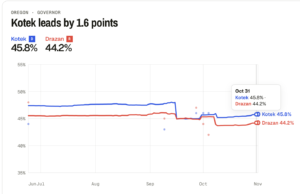
Here in Oregon, I’m mildly worried about Democratic Governor Tina Kotek being upset by Republican Christine Drazan. However, Silver gives Kotek a 84.4% chance of winning, down slightly from 84.9% on October 20. The race has only had seven polls in all of 2026, so there’s not much to go on. Silver only shows Kotek with a 1.6 point lead, but I suspect her final vote share will be double that, at least. That’s my hope, since it would be deeply disappointing for the Oregon governor race being an exception to a national Blue Wave.
Discover more from Salem Political Snark
Subscribe to get the latest posts sent to your email.