

Here’s my open letter, which will become an open email, to the nine members of Salem’s City Council. My subject is whether Betsy Vega meets the requirements in the city charter to be a city councilor.

***************************************************************
Dear Mayor Hoy and councilors Paul Tigan, Linda Nishioka, Shane Matthews, Deanna Gwyn, Irvin Brown, Mai Vang, Vanessa Nordyke, and Micki Varney:
As you’re aware, the City of Salem has issued a statement regarding Betsy Vega’s eligibility to be on the November 2026 General Election ballot after she was certified as the winner of the Ward 6 city council race in the May 2026 Primary Election.
Certificate of Nomination Decision Ward 6 – Public Statement 2026 07 06
This was the conclusion of the City Recorder:
Candidate Eligibility Determination
The City’s legal analysis concluded that the City Recorder, as the City’s elections official, has a duty to perform ministerial election actions, such as issuing a certificate of nomination, unless the elections official has knowledge that a candidate is not eligible. In this case, the City’s legal analysis concluded that Ms. Vega never established a new residence, or domicile, outside of the ward. Under the information reviewed and the applicable legal standards, there is not clear and convincing evidence that Ms. Vega established a new residence outside of the ward during the required residency period and was actively seeking a residential address inside the ward. Accordingly, the City Recorder will issue the certificate of nomination as required under Salem’s Elections Code and State law.
I’m urging you to exercise your responsibility under Section 25 of the City Charter to review the validity of the City Recorder’s determination that Vega is eligible to be the Ward 6 city councilor, because that determination is deeply flawed. Here’s a screenshot of Section 25. Note that Section 25 (4) says, “The council is the final judge of the election and qualifications of its members.” So the City Recorder’s determination is advisory to you, not a final decision.
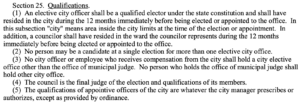
Section 25 (1) states in part:
In addition, a councilor shall have resided in the ward the councilor represents during the 12 months immediately before being elected or appointed to the office.
Yet the City Recorder ignored the fact that an outside counsel hired by the City of Salem, Truman Stone of Eugene, determined that Betsy Vega lived outside of Ward 6 from November 17, 2025 to March 4, 2026. That’s 107 days, about 15 1/3 weeks, almost four months. Stone said:
From November 17, 2025, to March 4, 2026, Ms. Vega testifies that she was homeless and stayed with friends and relatives in the greater Salem metro area, but outside of Ward 6.
See:
Memo _ re Nomination Eligibility 070626
The City Recorder acknowledged the city charter requirement cited above, saying in her statement:
To be eligible for placement on the November 2026 General Election ballot, the primary election nominee for a city councilor position must be an eligible elector (voter) under the Oregon Constitution and reside in the ward they seek to represent for the 12-month period prior to being elected, in this case beginning November 3, 2025.
Betsy Vega lived outside of Ward 6 for 107 days during that 12-month period. And Truman Stone said on page 14 of his opinion that the 12-month residency requirement prior to the November 3, 2026 General Election must be continuous.
For purposes of section 25 of the Salem Charter, “12 months immediately preceding” is best interpreted as a continuous, uninterrupted presence in the ward sufficient to maintain or establish domicile.
This is key. Stone failed to correctly cite Section 25 of the city charter. It doesn’t say “12 months immediately preceding.” It says “12 months immediately before being elected or appointed to the office.” More importantly, Section 25 doesn’t include the words “presence” or “domicile.” Those are terms that Stone decided on his own were relevant to a determination of whether Vega is qualified to be a city councilor.
The city charter says “a councilor shall have resided in the ward the councilor represents during the 12 months immediately before being elected or appointed to the office.” Resided. Not domiciled (if that even is a word). Not presenced (if that even is a word). Resided. And this is a continuous residing, according to Stone. Every day of the 12 months prior to November 3, 2026.
Yet Vega resided outside of Ward 6 for 107 days, about 15 1/3 weeks, almost four months during those 12 months. So how could Stone and the City Recorder determine that she met the residency requirement of Section 25 of the city charter?
By making up a novel argument that even though the city charter says that a city councilor “shall have resided in the ward the councilor represents during the 12 months immediately before being elected,” forget that word resided because domicile is the operative word. In their personal opinion, since again, the city charter says nothing about domicile.
Here’s a screenshot from Stone’s opinion:
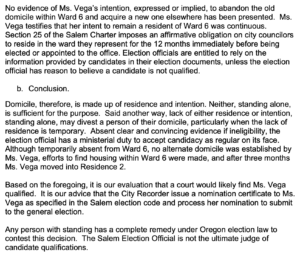
Stone starts off by speaking of domicile, which has a connotation in the law of being a permanent home or place a person has a substantial connection with. But then he shifts to speaking of Vega’s continuous intent to remain a resident of Ward 6. Well, fine, I have an intent to win a million dollars in the lottery. But so far that hasn’t happened, just as Vega’s intent to be a resident of Ward 6 didn’t happen between November 17, 2025 and March 4, 2026.
He then cites the requirement in the City Charter for city councilors to reside in the ward they represent for the 12 months immediately before being elected or appointed to the office. Great. I expected that Stone would address the question of how Vega could meet this requirement when she hadn’t lived continuously in Ward 6 for the 12 months prior to November 3, 2026.
Problem is, Stone fails to mention that Section 25 of the Salem Charter says that a city councilor must have resided in the ward for those 12 months. It doesn’t say presence. It doesn’t say domicile. It says resided. As in, you know, someone’s residence.
Then in his Conclusion, Stone speaks again of domicile as being made up of residence and intention. Fine, but irrelevant. Because the City Charter speaks of resided, not domiciled. And there is no doubt that Vega didn’t reside continuously in Ward 6 for the 12 months prior to the election.
Then Stone shifts away from speaking about Vega having a domicile in Ward 6, which apparently she didn’t, given her lack of a residence, into saying that no alternative domicile outside of Ward 6 was established by Vega. Again, irrelevant for the purpose of the City Charter requiring that a city councilor reside in their ward for 12 months prior to the election.
The City Charter doesn’t say that a city councilor can’t have a domicile outside of their ward. It says that a councilor has to have resided in their ward. Yet somehow Stone argues that because Vega didn’t choose to live permanently outside of Ward 6, this shows she is qualified to be a Ward 6 city councilor. The City Recorder echoed this in her own statement, saying, as noted above:
In this case, the City’s legal analysis concluded that Ms. Vega never established a new residence, or domicile, outside of the ward.
Irrelevant. Again, the city charter says nothing about a city councilor being required not to establish a new residence or domicile outside of the ward. It says affirmatively that a councilor shall have resided in the ward for 12 months prior to their election. Thus Vega isn’t qualified to represent Ward 6, because she didn’t reside in Ward 6 for 12 months prior to the election.
Keep in mind that the City Recorder has established a new interpretation of the residency requirement in Section 25 of the city charter. It is now the official policy of the City of Salem that a city councilor doesn’t need to have lived in their ward for the 12 months prior to being elected. It is now sufficient that a city councilor has the intent to live in their ward, even if they failed to reside in their ward for much or even most of those 12 months.
So if the City Council fails to review whether Betsy Vega met the residency requirement for councilors in the city charter, it will leave in place the City Recorder’s ruling that intent and domicile are the operative words in determining whether a councilor resided in their ward for the 12 months prior to being elected. Forget “resided.” That’s just what the city charter says. A Eugene attorney said that intent and domicile are the correct terms. Why? Because he said so.
That shouldn’t be good enough for the city council. Which is why I urge you to exercise your duty under the city charter to determine whether Betsy Vega is qualified to be a city councilor. Doing nothing is doing something — allowing the novel interpretation of the city charter by Stone and the City Recorder to become the official policy of the City of Salem even though it conflicts with the plain language in Section 25 of the city charter.
Sincerely,
Brian Hines
Salem, Oregon
Discover more from Salem Political Snark
Subscribe to get the latest posts sent to your email.