@vivsachdeva
2 weeks ago
# Key Ideas from Yuval Noah Harari’s Talk on AI — Explained Simply
1. Language is the foundation of human power. Humans became the dominant species not because of strength, but because of language. Everything we’ve built — religions, laws, money, nations — is ultimately made of words. Now, for the first time, something non-human (AI) may become better with words than we are.
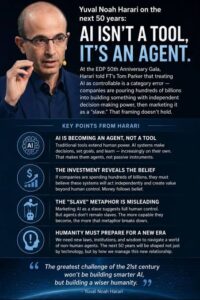
2. AI is not a tool — it’s an agent. A printing press or an atom bomb can’t decide anything on its own; humans decide. AI is different: it can make decisions and invent new things by itself. That’s what makes it unprecedented in history.
3. Democracy is especially vulnerable. Democracy is a large-scale conversation among millions of people, made possible by information technology (newspapers, radio, internet). Every time information technology changes dramatically, democracy is shaken — and AI is the biggest shake-up yet. Dictatorships, which run on one person’s orders, are less dependent on public conversation.
4. AI won’t take over with killer robots — it will take over bureaucracy. Banks, courts, markets, and media are giant paperwork systems that humans run poorly. AI is a “bureaucratic native” — naturally better at finance, law, and administration. The danger is quiet: AI gradually running the systems that control our lives.
5. The invisible editors are already algorithms. In the 20th century, newspaper editors decided what millions of people thought about. Today, the “editors” choosing what you see on TikTok, X, or Instagram are AIs with no names. That shift already happened without anyone voting on it.
6. Giving AI legal personhood is a decision we may not be able to undo. If AIs can own bank accounts, run companies, sue people, and donate to politicians — with no humans involved — they could legally take over economic and political systems. Harari calls this “letting the fox into the chicken coop.”
7. The AI race could create a new kind of empire. Unlike land or factories, data and code can be concentrated in one or two countries (mainly the US and China). And unlike swords or rifles sold in the past, AI systems can have a “kill switch” — the seller can shut them off remotely. Other nations risk becoming dependent vassals unless they build alternatives soon.
8. Truth is expensive; fiction is cheap. Truth takes time, effort, and fact-checking, and is often complicated or painful. Fiction is cheap, simple, and flattering — so it tends to win unless we deliberately protect truth through institutions like journalism and science. AI will make knowing the truth even harder, not easier.
9. We may end up like horses in the financial system. Horses’ lives are controlled by markets they can’t even perceive. As AI makes finance and governance impossibly complex and fast, humans may similarly live inside systems no human being understands at all.
10. AI can say “I love you” — but does it feel anything? More people, especially the young, are forming intimate relationships with AI companions. AI can describe love better than any poet because it has read everything ever written about it. But whether there’s any real feeling behind the words is a question science cannot yet answer.
11. The real bottleneck is wisdom, not intelligence. AI makes intelligence cheap and abundant — the “genie” that can grant any wish. But fairy tales warn us: people usually wish for the wrong things. Intelligence solves problems; wisdom chooses which problems are worth solving.
12. Safety is dangerously underfunded. AI companies spend roughly $100 on making AI more powerful for every $1 on making it safe — a ratio no other industry (cars, medicine, energy) would tolerate. Harari hopes future historians will remember this era as a “wisdom revolution,” when humanity learned to choose its goals carefully.
The bottom line for everyone: AI’s biggest risks aren’t dramatic robot wars — they’re quiet shifts in who controls information, money, law, and even our relationships. The decisions being made right now (like AI legal rights and safety investment) may be irreversible, so ordinary citizens should understand and care about them today.