

The United States is so politically divided, it’s wonderful that Democrats, Republicans, and independents have come together on one important national issue: dislike of data centers.
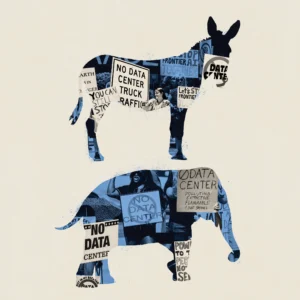
This image illustrated a Comment by Benjamin Wallace-Wells in The New Yorker’s “The Talk of the Town” feature in the August 17, 2026 issue: Reading the Data. The digital version is titled, A.I. is Now a Major Election Issue. With the sub-heading, As Abdul El-Sayed, Michigan’s newly elected Democratic nominee for the U.S. Senate, put it, “People really effing hate data centers.” I’ll share a PDF file if that link doesn’t work for non-subscribers.
A.I. Is Now a Major Election Issue | The New Yorker
Here’s how the piece starts out:
This summer, as the ideologically fractious Democratic primaries begin to recede and the politically pivotal midterm elections edge nearer, candidates and voters alike have had their attention drawn by vast, humming edifices newly constructed on the outskirts of towns. Abdul El-Sayed, an epidemiologist and former public-health official who finished a deft insurgent campaign by becoming Michigan’s Democratic nominee for the U.S. Senate, sounded a theme that helped decide primaries in his state and in Kansas last week. “People really effing hate data centers,” he said.
That kind of consensus is rare in politics right now. About seventy per cent of Americans, including sixty-three per cent of Republicans, oppose building the hyper-scale centers that power the A.I. boom in their area, according to Gallup, but more than four thousand centers have been built across the country, and about four thousand more are planned. Politicians, first from the left and then from the center and the right, have spent the past few months hastily distancing themselves from them.
Bernie Sanders and Alexandria Ocasio-Cortez proposed a federal moratorium on new data centers in March, and the pragmatic governor Kathy Hochul enacted the first statewide one in New York in July. The rallying cries against A.I. can themselves sound a bit as if ChatGPT wrote them. “It’s time to press control-alt-delete to put a stop to this A.I.-data-center crisis,” a closing ad for Francesca Hong, a democratic socialist who is the front-runner in this Tuesday’s primary for Wisconsin governor, announced. Still, when something is this unpopular, blunt talk can work.
It seems to me that Democratic candidates in the upcoming November midterm election are going to benefit more from the backlash to data centers, because Republican candidates generally are more supportive of the corporations that fund, build, and profit (they hope) from data centers. Plus, Trump has taken a laissez-faire attitude toward AI, which needs data centers for development, maintenance, and improvement of AI models.
So Republican candidates for federal, state, and local offices probably are going to be more reluctant to express strong opposition to data centers than Democratic candidates — though I doubt few will come out strongly in favor of them, given the current political climate toward data centers. It’s more difficult to predict how candidates will talk about AI, even though AI and data centers are closely linked.
I use Claude, ChatGPT, and Google’s Gemini frequently. Daily, typically. I just find it much easier to get high quality, comprehensive, quick answers to my questions from an AI model than the old way of clicking on links that appear from a Google search. AI can retrieve, digest, and summarize those links rapidly in perfect English, a huge time saver.
That’s why I’m uncertain about whether the data center planned for the Mill Creek Corporate Center here in Salem, Oregon is a good or bad idea. For me it depends on whether Verrus, the developer, is able to clearly demonstrate that the data center will have minimal negative environmental impacts: electricity use, water use, noise level.
The last paragraph of The New Yorker story speaks of AI.
The moratoriums themselves may not be particularly consequential to the advance of artificial intelligence—many data centers have already been built, and others can be constructed in friendlier jurisdictions, or even overseas. In May, the Anthropic C.E.O., Dario Amodei, waved away the political challenges. He said, “We’re going to find that ideology will not survive the nature of this technology. It won’t survive reality.” The things he was talking about, he added, “are gonna become bipartisan and universal because everyone will recognize the necessity of it.” On the campaign trail, in Michigan and elsewhere, something like the opposite is happening.
Discover more from Salem Political Snark
Subscribe to get the latest posts sent to your email.