

Trigger warning: if you love books, and hate to see them mistreated, you might want to partially cover your eyes when viewing the photo below. I'm sorry that this blog post has to be so graphic, but as the saying goes, A picture is worth a thousand words.
(And this post is much longer than that.)
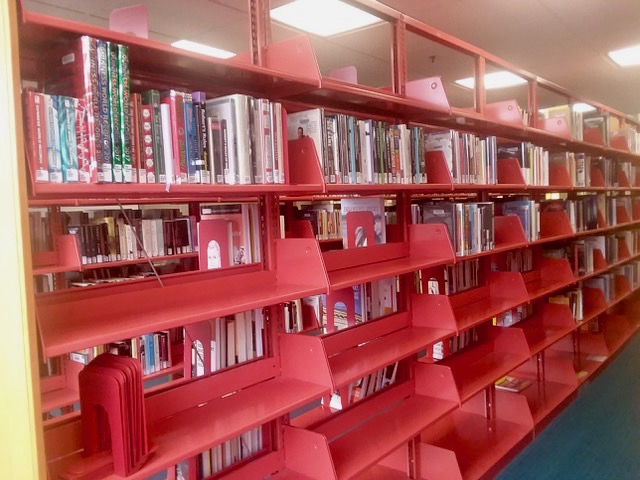
Jim Scheppke, a community activist and ardent library supporter, worked for the Oregon State Library for 25 years, 20 of them as library director (this is the library for the State of Oregon, not the Oregon State University library). Today he sent me this photo, along with other information I'm sharing below.
This is how he described the photo of shelves at the Salem Public Library. Again, this is explicit language that may bring tears to the eyes of book lovers. But the truth must be told.
Red Alert Brian!
At the direction of the City Librarian, librarians have been discarding many hundreds of books since the beginning of October. She disputes that she told the librarians to discard 30% (see below), but according to my sources that was how the instruction was interpreted.
Here is the beginning of the Dewey non-fiction ranges just after the evil deed was done (they may have spread things out by now). They started at the 000s and have been through the 100s (including Philosophy) and 200s (including Religion). Here is what one range looked like when they were done.
Dear City Librarian Strahl:Aside from working with Judy Martin to lead the winning library bond measure campaign a couple years ago, I have tried to steer clear of involving myself in issues concerning your library. However, it recently came to my attention that library staff was told in a staff meeting at the end of September that they were directed to withdraw books from the library print collection totaling 30% of the entire collection.I am very alarmed by this and think it is bad decision for many reasons. I am prepared to advocate strongly to reverse this decision, but first I wanted to give you the opportunity to tell me that I am mistaken about this. I would be relieved to be mistaken. But if I am not mistaken, I would like to know as a Salem citizen whether this bad decision to discard 30% of the print collection was approved by the Library Advisory Board. I would also like to hear an explanation of why the administrative staff at the library feels it is necessary to reduce the library print collection in this radical way.If indeed the SPL is in the process of discarding 30% of the library print collection, I find this to be an clear violation of the recently Council-adopted Collection Development Policy that states: "The library provides information resources in physical and electronic formats in an effort to deliver the broadest possible access to content both within and beyond the library’s walls. The primary responsibility of the Salem Public Library is to serve the Salem community by providing a broad choice of materials to meet informational, educational, cultural, and recreational needs" (emphasis mine).My opinion is that the library print collection is not too big. On a per capita basis using the most recent data from the State Library for 2016-17, the Salem Public Library holds print items equalling 2.08 print items per capita. I think this figure is overstated because the State Library uses the Salem city population as the service area population. You and I know the service area population of the Salem Public Library is really a lot larger because of all the CCRLS cardholders.Anyway, even using the State Library figures, a collection of 2.08 per capita is below the median for all Oregon public libraries serving populations over 25,000 (27 of them) of 2.33 per capita. If the print collection were reduced by 100,000 the per capita print collection would fall to only 1.46 per capita. This would make it the 4th smallest collection per capita of all Oregon public libraries serving populations greater than 25,000.There are other ways I could argue that our print collection is not too large and should not be reduced by 30% (or at all), but I will stop here and respectfully request that you address the three questions above: 1) Am I mistaken about this? 2) Did the LAB approve a 30% reduction? and 3) For what reasons is this being done?I will look forward to hearing from you.Jim
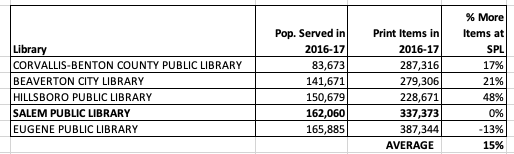
Next, here's a message Scheppke sent me that contains statistics to back up his assertion that it is wrong to claim that the Salem Public Library has, on average, 30% more print books than peer libraries.
Brian:
Fighting words! (For a librarian, at least.)
I also received some background information from Scheppke that he didn't want me to share directly. You know, sensitive "sources and methods" stuff, if you've been following intelligence agency goings-on involving the U.S. Congress.
Suffice it to say that according to high, medium, or low-level sources within the Salem Public Library, or maybe somewhere else — don't want to be more specific than that — there's reason to question the assertion you can read below by City Librarian Strahl that staff weren't given a clear directive to cull at least 30% of print books from the library's collection.
I will quote the following part of Scheppke's message that is shareable:
OK. That's Scheppke's side of the story. Here's how City Librarian Strahl responded to his initial message.
Dear Jim:Thank you for your question about our collection policy. You asked about whether there was a directive in place to reduce the collection by 30%. There is no reference to a percentage in the library’s Collection Development Policy or in any specific instructions to staff.I reviewed the minutes from the September 27, 2018 staff meeting you reference (which were shared in writing with all staff), and they say: “SPL collection is 30% larger on average than peer libraries. Sarah clarified that this does not mean that SPL staff will be asked to weed 30% of the collection. This figure gives perspective on collection size and that other criteria will guide any weeding that occurs (condition, use, etc.).”The 30% figure in question was developed in consultation with the State Library of Oregon Data & Federal Programs Consultant Ross Fuqua and a statistical study of nationwide peer library physical collection size. Mr. Fuqua assisted SPL staff in not only gathering statistics but also helping interpret and verify the findings. However, this figure is only a single data point for added context as we start the processing of renewing the collection on the foundation of the Collection Development Policy.The Library Advisory Board (LAB) recommends rules and policies to Salem City Council. The LAB members unanimously approved the library’s Collection Development Policy on August 8, 2018 with the intent to create a vibrant, current collection that reflects the community’s needs and current use patterns. City Council also lauded the newly-created policy. Collection maintenance is incredibly important work that is part of our greater overarching goal of having a modern, renewed library for the residents of the City of Salem. Our focus is on the collection’s quality and ability to serve the needs of the Salem community now and far into the future.Per the policy, the Salem Public Library’s collection is a popular materials collection, with varied and current content on a range of subjects. The library’s collections are dynamic, with an emphasis on up-to-date and in-demand materials. In order to maintain a relevant, popular, and appealing collection, the library engages in ongoing evaluation and updating of owned materials.The library uses best practices and industry-standard tools to make data-driven decisions about the collection. While working within the framework set out in the Collection Development Policy, we use the CREW method (a national best practice developed by the Texas State Library) to evaluate the collection which allows us to strive to maintain a collection that is vital, relevant and useful.We also use a product called CollectionHQ, which gives us use metrics, turnover rates, and identifies under- and over-stocked subject areas. With these outlined methods and derived data, we can identify items that no longer circulate, items in poor condition, and outdated information in areas of rapid change such as medicine. We also look for superseded editions, excess copies of previous bestsellers, and worn copies that need to be mended or replaced.In addition to renewing the collection, this type of collection maintenance also frees up shelf space for the constant arrival of new material, provides ease of access to desired materials, and identifies areas where we need to update or add new items.In preparation for the upcoming renovation project and in order to be good stewards of public funds, it is crucial that the library takes a comprehensive look at the entire collection before moving out. This will ensure only current materials in good condition and in demand by our community are moved with the library.As part of the CCRLS cooperative, we have access to resource sharing through the consortium as well as access to the rest of the state through Interlibrary Loan. We rely on CCRLS to help us get materials for our patrons just as other consortial members can use our materials. Ultimately, our collection’s purpose is to reflect the needs of the Salem community.Sarah StrahlCity Librarian
With the book-ball back in Scheppke's side of the court, here's how he responded to Strahl.
Dear Sarah,
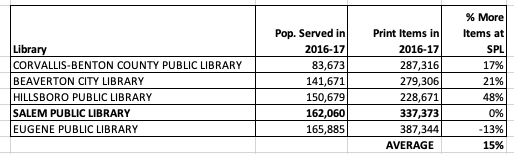
OOH! I like that last sentence. It's pleasingly ominous, without being in-your-face attacking. After all, Scheppke used the words "I respectfully ask…" in the preceding sentence.
This Battle of the Books between Scheppke and Strahl is intense, but since they're both librarians, it's polite — at least compared to other sorts of political/policy battles at the local, state, and national levels.
(Note: if you've read all the way through this post, congratulations! You've just read 2,344 words. I wish I could give you a sticker that says "I read a REALLY LONG blog post today. Have you?")
Discover more from Salem Political Snark
Subscribe to get the latest posts sent to your email.
This is an outrage. I personally depend on the library for a lot. I cannot get there anymore but the library comes to me in the form of Operation Bookshelf. Fiction is one thing that comes and goes but the technical is vital to an informed public.
Thanks Brian. Here is a pertinent quote from Susan Orlean’s new book called The Library Book that I highly recommend to library lovers …
“Books are a sort of cultural DNA, the code for who, as a society, we are, and what we know. All the wonders and failures, all the champions and villains, all the legends and ideas and revelations of a culture last forever in its books. Destroying those books is a way of saying that the culture itself no longer exists; its history has disappeared; the continuity between its past and future have ruptured. Taking books away from a culture is to take away its shared memory … Destroying a culture’s books is sentencing it to something worse than death: It is sentencing it to seem as if it never lived.”
Brian, Thank you for publishing and highlighting the library book disposal process. Thank you, Jim, for raising the issue. Without willing citizen participation City employees, whether credible, accurate, or transparent, become the default decision point and information source .
Experience has taught me how easily well intended individual projects do not always reflect community values. Is library book removal a community issue? I commend the both of you for disclosing the decision and implications of that process.
I also invite you to consider the following four questions:
How can my want be best translated into a community goal?
When does a personal view of the world become a community obligation?
Why should I expect other members of our community to endorse my view?
What strategy will translate my views into an achievable community goal?
I encourage all Brian blog readers to answer and then act upon these questions.
Where did all of the books go?
In storage? In the garbage?
Who has the answer?
All I know is that when I look for books that interest me in the online catalog, they are never there. Neither modern nor time-honored. I am mostly interested in nonfiction.
It didn’t used to be that way.
This is outrageous. The city has already gutted the West Salem library. Absolutely sickening!
I don’t believe anyone in the state of Oregon knows more about libraries and book inventory than Jim Scheppke. I totally trust his opinions on this matter.
I believe this process of getting rid of books needs to stop immediately and get a closer look. Public input is important and necessary.
I would like to counsel some restraint before we all go ballistic. There are a few additional salient facts that should be taken into consideration. Not the least among them is the comparison between Hillsboro Public Library and Salem Public Library which seem most closely aligned in population served. Except that Hillsboro, for all its similar community size, has a annual budget that is over TWICE what Salem’s is.
Either we trust the people we have hired to oversee and operate our public library in the most efficient, effective, and beneficial to the most people, manner, or “the community” will end up voting on the retention of the collection, one worn out obsolete volume at a time.
Liz S. said, “……..retention of the collection, one worn out obsolete volume at a time. ”
I need to install a new timing chain on a 1957 Ford 312 V8.
Where can I go to find all of the specifications and procedures for that?
What’s obsolete to some is most certainly NOT obsolete to others.
Once it’s gone; it’s gone.
Skyline, No one is assigning a value to your 1957 Ford manual. But you want 60+ year old car manual. Why would asking the library to obtain a copy for your use when you turn up and ask for it not be as agreeable a solution to your problem as insisting that it be kept on the shelf in Salem awaiting YOUR whim to come in and expect it to be on the shelf?
Once it’s gone, it’s usually available somewhere that has more money, more space, and possibly a mission to collect antique car manuals, just as an example.
That doesn’t happen to be Salem’s situation. Salem Public Library is space strapped, poorly funded, and doing the best they can under the circumstances. I believe we owe them our support for the mission to provide the most they can to the community at large.
I’ve had fairly decent luck finding specs and procedures online.
The question before us seems to be: What is the idea of an adequate public library for Salem?
Ms. Strahl has indicated in very general fashion what some of the criteria are for building/managing the collection. These include, but are not limited to, “the CREW method (a national best practice developed by the Texas State Library) to evaluate the collection . . . . , [striving] to maintain a collection that is vital, relevant and useful” and “a product called CollectionHQ, which . . . . [provides] metrics, turnover rates, and identifies under- and over-stocked subject areas . . . . [allowing one to] identify items that no longer circulate, items in poor condition, and outdated information in areas of rapid change such as medicine.” I accept at face value that Ms. Stahl utilizes these tools and others in good faith to manage our library.
That said, the devil is in the details. To know that the current collection management tools are sufficient to meet the community’s vision for the library requires more detail and conversation between Ms. Strahl and a representative group from the community to review these questions in a mutually accepted and collaborative process.
I do not know how these sorts of task-force are set up within the Salem City government, but it does not seem entirely out of the question that this can be done in some form that gives everyone confidence that the community vision for the library is being honored in its management. It is also possible that this community vision may not be as well understood as we would hope. It’s simply unclear at this time. Such a task force could clarify the community’s understanding of its own vision as well.
In any event, I think it would serve us all well to take a deep breath and to assume good faith on everyone’s part, moving forward to establish a process that can give us confidence that our library is being managed in a way which serves our community’s best interests.
Respectfully,
John Hofer
I am late at becoming aware of this issue. From what I have read, I have to currently agree with Jim Scheppke that the removal of these books is premature since the future availability of book space has yet to be determined. I am not currently aware of the reasons for the planned renovation. If it is to make the structure earthquake resistant, we should wait and see what the developed plan reveals regarding space. If this is not earthquake related, I have to wonder why a renovation is even needed or why it would reduce space for books…which is the reason for having the library in the first place. I was just in the library a few months ago. It is already an attractive library…so a planned renovation seems odd. I guess I need to get information on the purpose for this renovation.
April 14, 2019: I looked up this older post after reading a letter to the editor written by Jim Scheppke that appeared in today’s Statesman Journal, which I quote it in its entirety:
“At the recent Friends of the Library book sale, many important, timeless books in good condition that were removed from the shelves on orders from library management a few months ago were sold for pennies on the dollar.
“For example, I purchased a National Book Award-winning poetry book for $1.25 — a hardback in excellent condition. I checked the library catalog and discovered A PAPERBACK COPY OF THE SAME BOOK HAS BEEN RE-ORDERED AND WILL BE ‘AVAILABLE SOON’. [caps mine]
“The cost of replacing the perfectly good hardback that was removed with a paperback, including processing labor, will be well over $20. What a waste! Duplicate that example a few hundred times and you are talking real taxpayer money.
“On April 22, the City Council will decide whether to resume the mass book removal project as recommended by the Library Advisory Board. I hope they will take their responsibility to be good stewards of the public purse seriously and reject the recommendation.”
Sheppke, whose bona fides as Oregon’s State Librarian for over 20 years, carry great weight with me, and I thank him keeping this proposed policy before us.