

Liberals like me hate what used to be called Trump's Big Beautiful Bill before Senate Democrats deleted that name for an excellent reason (it's big, and a bill, but isn't at all beautiful). Among other things it will:
— kick many millions of Americans off of Medicaid and the Affordable Care Act
— make permanent tax breaks for corporations and wealthy people at the expense of poor people
— cripple our country's renewable energy industries, leaving China to lead in this area
— increase the national debt by $3-4 trillion
— throw many billions of dollars into deporting hard-working undocumented migrants
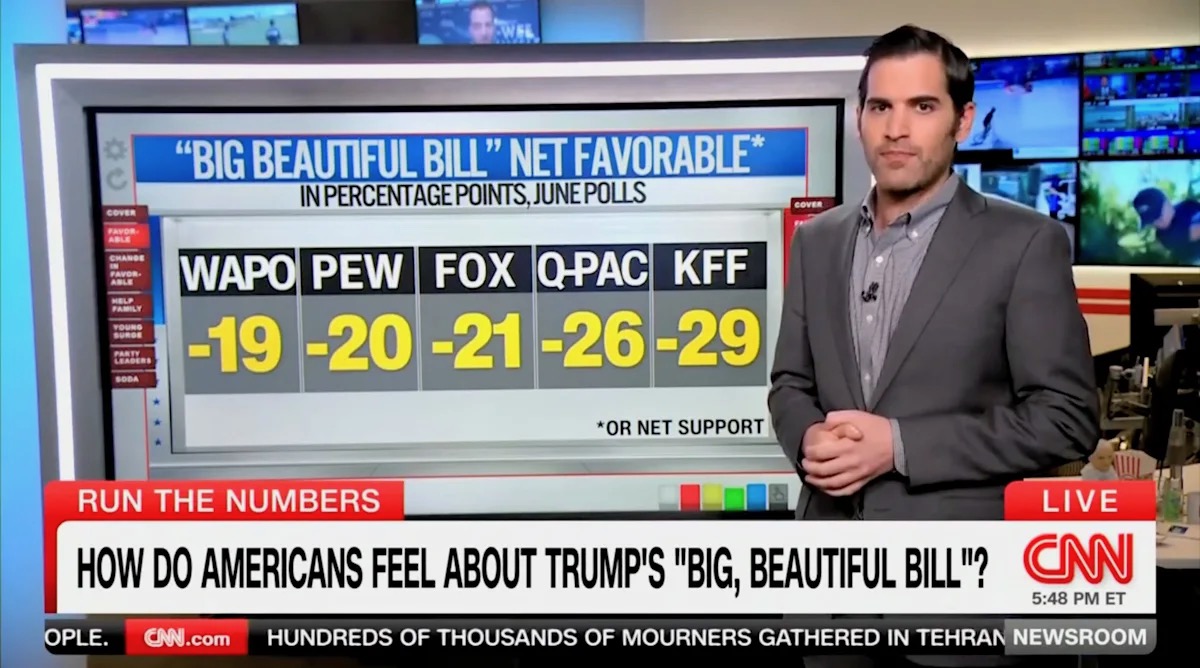
Polls show that Americans dislike Trump's megabill by about 60-40. That's to be expected, given that the people the megabill benefits are many fewer than the people the megabill hurts.
But a Politico story discusses an issue that I hadn't thought of before — how the megabill doesn't help Trump's Republican Party (there are no GOP policy positions aside from whatever Trump wants) form a long-term governing majority.
Here's how "The Limits of Trump's Revolution Are Laid Bare by the Megabill" starts out.
In the service of pushing his tax-and-spending megabill over the finish line, Donald Trump has spent recent days cajoling, threatening and meeting with lawmakers. His message to them was simple.
“It’s a great bill,” the president explained at a Florida event Tuesday. “There is something for everyone.”
It’s an astonishing oversight. Over the past decade, Trump has unleashed the tectonic forces of political realignment. He has torn his party down to the studs and then remade it in his image. He has splintered the Obama coalition and accelerated a class-based political reordering that stands to upend nearly a century of convention. His most recent win was marked by a more racially and ethnically diverse voter coalition than in his two prior campaigns.
These are accomplishments most presidents have only dreamed of. Yet the centerpiece of Trump’s legislative agenda does almost nothing to harness any of it in the service of a permanent MAGA governing majority. He is spending every last cent of his political capital on a bill marked by its lack of ambition and vision.
It suggests real limits to the MAGA revolution, either because the coalition is inherently brittle or because of the stiff challenges Trump still faces in transforming the GOP, even as he utterly dominates it.
This was the moment to announce the arrival of what could be a multi-ethnic working-class coalition. The time to deal a crowning blow to a feckless opposition party that remains convinced the only thing holding it back is ineffective messaging. Instead, the White House produced a domestic policy bill that could have just as easily been produced by any generic Republican administration.
There’s no Nixon-goes-to-China policy surprise, no dramatic break from the familiar. Nothing bold to suggest the unique populist coalition he has assembled or to cement it in the decades ahead. Its signature idea, tax relief, is meaningful — and shouldn’t be minimized — but that’s always been a core GOP tenet. So has a generalized commitment to growth and prosperity. Spending on border security addresses a critical need, but isn’t inherently additive.
Much of the bill smacks of a reassertion of decades-old Republican policies and an embrace of party orthodoxy. It is easily caricatured as a giveaway to the wealthy that also slashes health care, a piñata for Democrats to bash and ride back to a House majority.
One astute conservative student of the realignment likened the legislation “to a death march through a series of choices that nobody really wanted to be making.”
“[It’s] not something that has an especially coherent logic to it or much prospect of actually accomplishing the things that I think people want,” Oren Cass, founder of the think tank American Compass and a leading advocate of conservative economic populism, told POLITICO Magazine recently.
The failure to imbue the legislation with more of a Trumpist ideological throughline may be due to a few factors; perhaps it’s Trump’s well-known aversion to wonky policy details, or the fact that most Republican lawmakers are still loyal to the Reaganite economic policy they came up with even as they now publicly bow to Trump.
But whether the sprawling bill is ultimately judged a policy success or failure, it lacks an original vision to hold together the constituencies Trump has improbably knitted together — tax relief, border spending, safety net cuts and Biden policy rollbacks aren’t a theory of the case. Sure, it has a few Trumpian frills that nod to the president’s populist campaign pledges, but they are largely small-bore and were scaled back by senators anyway. “No tax on tips” became a temporary tax deduction on tips, for instance. The brief musings about a tax hike on upper-income earners quickly were extinguished by opposition from Republicans on Capitol Hill.
Decades from now, no one will point to this legislation as a key building block of a lasting Republican coalition. It’s more likely to be remembered for the estimated $3.3 trillion it is set to add to the national debt.
Discover more from Salem Political Snark
Subscribe to get the latest posts sent to your email.