

Last Thursday I spoke with a KATU reporter about the news that Governor Kotek had blocked the sale of property owned by the state that was going to be used by a data center proposed to be built in south Salem’s Mill Creek Corporate Center.
Referring to the massive turnout at last Monday’s City Council meeting of people who were almost entirely opposed to the data center, I said:
This is democracy in action. People came out. Loud, angry, sometimes impolite. It got the city’s attention. And it looks like it got Governor Kotek’s attention.
When I heard that Kotek had withdrawn the property sale to Verrus, the corporation trying to build the data center, I shared that news on Facebook, saying that it looked like the project was on critical life support, and maybe even dead.
Well, miracles happen. Or more accurately, corporate hardball happens.
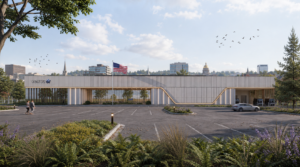
Because the next day, Friday, Verrus had changed the location of the data center, but not its intentions. Here’s how a Salem Reporter story by Les Zaitz, “Data company advances Salem plan, replacing state land and beating moratorium,” starts out.
The California company working to erect a data center in Salem applied for its first city review on Friday, beating by three days the consideration of a moratorium on such projects by the Salem City Council.
The filing by Verrus detailed what a company official said is the first phase of its Salem project – two buildings with about 600,000 square feet on about 100 acres of land in southeast Salem. The project, valued at $394 million for the first phase, would be in the Mill Creek Corporate Center and adjacent to Corban University.
So after Verrus lost 32 acres of state-owned land out of the 75 acres that it initially planned to use for the data center, it came up with three privately-owned parcels totaling 110 acres. And it filed an application with the City of Salem prior to a moratorium on data centers going into effect. The moratorium is slated to be discussed by the city council at a special meeting tomorrow, August 3.
In the staff report for the special meeting (contained in link above), city attorney Dan Atchison said:
Any land use application that is submitted prior to the adoption of a moratorium or the effective date of the passage of an ordinance amending the City’s land use regulations is not subject to either the moratorium or amended land use regulations. See, ORS 227.178(3) (Approval or denial of an application must be based on the standards and criteria that were applicable at the time the application was first submitted).
The timing of any proposed moratorium or land use regulation amendments is an important consideration because applications submitted before the effective date of those actions may continue to be reviewed under existing regulations.
Since Verrus planned to spend $5.1 billion on the Salem data center, and reportedly has close ties with Google, it wouldn’t be surprising that the corporation could afford high-quality legal advice that caused it to file an application with the city three days before a data center moratorium goes into effect. As Atchison noted, this likely will allow Verrus to move forward under existing regulations and land use policies, regardless of whether the city council votes for a moratorium.
If this happens, opponents will be outraged. Finger-pointing at whoever was responsible for this debacle — a data center being allowed to be built in the face of strong opposition by both the community and city council — will take place.
So who was responsible?
Reasonable people will disagree on the answer to this question. My feeling is that the blame falls on City Manager Krishna Namburi and the planning staff who worked with Verrus for many months on pre-application discussions and negotiations. Here’s how I described the process in a previous post.
As the Oregonian story notes, Verrus applied for the property tax abatement during a period when a NDA (nondisclosure agreement) with the City of Salem prevented citizens from knowing what was going on. The NDA was in effect from April 10, 2025 through July 8, 2026. During this time city officials engaged in what they call a Pre-Development Application Process. Quite a bit went on outside of the public eye, but all of this preceded an actual development application.
For a year and a quarter, 15 months, city staff worked away on helping Verrus with its data center project. This wasn’t known to the citizens of Salem because of the nondisclosure agreement. And the only reason Namburi and other city officials ditched the NDA on July 8, 2026 was because word had leaked out about the planned data center.
I asked Claude, my favorite AI model, how much was known in April 2025 about the dangers or negative effects of data centers. You can read Claude’s full response here. This was its summary.
So in short: the core economic and resource concerns (electricity costs, grid strain, water use, land use conflicts) were already reasonably well understood and reported by April 2025. The more granular health, noise, and specific legislative/regulatory responses were still emerging and became much more developed over the following year.
This connects to the same set of issues you’ve been tracking with the Verrus/Oakline proposal in Salem — the enterprise zone and grid-strain concerns there mirror exactly this national pattern.
Thus City Manager Namburi and other city officials must have been aware of what a hot topic data centers were even back in April 2025. And during the ensuing 15 months the nondisclosure agreement was in effect, Namburi and the city officials must have become increasingly aware of heated opposition to data centers in communities across the nation.
This is why I think it was management malpractice to keep both the city council and the public at large uninformed for a year and a quarter about Verrus’s proposal for a Salem data center. If this had come to light sooner, there would have been time for a considered community discussion about the pros and cons of the proposal — which might have led to a carefully thought-out moratorium on data centers before an application was submitted.
Now, it looks like Verrus has a good chance of being able to build the data center, regardless of what the city council decides to do, moratorium-wise. Perhaps a permanent citywide ban on data centers could pass legal muster and stop Verrus. Otherwise, opponents are going to be left wondering “if only…”, and many acusatory fingers will be pointing at Namburi and other city officials.
Discover more from Salem Political Snark
Subscribe to get the latest posts sent to your email.
When do you think Mayor J Hoy became aware of PGE’s involvement w SEDCOR?
Thanx for being you Brian