

Having done quite a few interviews with local television news reporters over the years, I’ve learned that I should feel fortunate if a few seconds of my much longer brilliant observations on some subject make it into the televised story. After all, they only have a few minutes to tell the entire story, and I’m just a small part of that much bigger picture.
So one of the last things I said to Jennifer Singh, the KATU (Portland) reporter who interviewed me yesterday about a major new development in the Salem data center saga, was something like, I really enjoyed talking with you; if you can use a few seconds of what I said in your story, great.
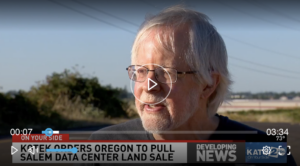
So when I watched the recording I’d made of the 11 pm news on KATU, I was thrilled to see that not only was “Gov. Tina Kotek orders Oregon to withdraw land sale for Salem-area data center” the lead story on the newscast, my face and words appeared in the first few seconds of the story.
This is democracy in action. People came out. Loud, angry, sometimes impolite. It got the city’s attention. And it looks like it got Governor Kotek’s attention.
Here’s the print version of the story, which includes some quotes from me that didn’t make it into the televised version.
SALEM, Ore. (KATU) — Gov. Tina Kotek has ordered the state to withdraw its land sale for a controversial data center near Salem.
Kotek ordered the Oregon Department of Administrative Services (DAS) to cancel the state’s contract with California-based technology company Verrus at the Mill Creek Corporate Center in southeast Salem.
Kotek announced the decision Thursday, saying the state should manage public land in a way that benefits local communities and reflects Oregon’s priorities for affordability, responsible economic development and protecting natural resources.
“This decision is about my responsibility to make sure state actions reflect Oregon’s values and serve the public interest,” Kotek said in a press release. “I believe in growing Oregon’s economy and welcoming new investment, including in the technology sector. But growth has to make sense for the community, for our infrastructure, and for our natural resources. Oregonians have made it clear they expect thoughtful, responsible decisions about projects of this scale, and I agree.”
In a statement to KATU, Verrus said it was disappointed in the governor’s decision.
“While we understand the community’s concerns around data centers, each project should be judged on its merit,” it said in part. “This decision was made unilaterally and without consultation — before Verrus had the opportunity to present its design, infrastructure plan and community benefit proposals to address these concerns and demonstrate our shared commitment to Oregon’s values.”
Salem leaders only recently revealed details of the $5.1 billion data center proposal that would have been one of the largest private investments in the city’s history.
According to a DAS spokesperson, DAS contractually agreed to sell a 32.23-acre section of land within the Mill Creek Corporate Center in May 2025, with a closing date for the transaction set for October 2026.
The proposal drew both support from local construction unions and concern from residents during recent council meetings.
“The protests that came out at last Monday’s City Council meeting was the most intense and emotional; in just the sheer numbers they’ve ever seen on any subject in Salem,” said Salem resident Brian Hines.
He went on to say, “I had mixed feelings, but now I think I’m happy [with Kotek’s decision], because it shows, like the sayings go at every protest that I’ve been to, you know, this is democracy in action when people come out loud, angry, sometimes impolite, but it got the city’s attention, and it looks like it got Gov. Kotek’s attention.”
Kotek said she supports economic development and new investment, including data centers but believes large projects should be evaluated for their impacts on infrastructure, water, energy and local communities.
“I’m proud to live in Oregon because the green, the cleanliness of it, but when you start bringing these data centers in, that’s not gonna be clean and green anymore,” said Hannah Shooting Bear, Salem resident and founder of Indigenous Now.
Verrus told KATU the data center would be built in a way that uses less water and electricity and would bring 75 permanent jobs and millions in tax revenue to Salem.
“Verrus came into the local community actively listening and seeking meaningful conversations with residents, neighbors, and business leaders,” Verrus told KATU in its statement. “That is why we proactively announced Oakline before a formal application was filed. We wanted to give everyone in the Salem community – including residents, neighbors, tribes, and city leadership – the opportunity to ask hard questions and help shape the project with a formal community benefits agreement.”
“We set out to show that Oregon could set an example for how better data centers can be built – ones that address the issues local communities face with digital infrastructure projects,” it continued. “Verrus has been participating in Oregon’s Data Center Advisory Committee and recently presented members with an overview of the Verrus’ model of responsible data center development that reduces water use, supports the electric grid, and delivers strong community benefits.”
“I mean, it’s true that if the United States doesn’t develop artificial intelligence, other countries will, and they may do it less responsibly than we can,” Hines said.
Hines said the issue for some is not the project itself, it’s what could potentially come as a result.
“With artificial intelligence, experts say we’ve got years, a couple of years to adjust, before the impacts on society are so great, you know, and so many people start being laid off,” he said. “You could see the outcry the City Council made last Monday; multiply that all across the country where people are losing their jobs, and just going, ‘No, we need to shut this whole thing down.’ I mean, it could become, you know, ugly fast.”
Salem City Council plans to meet this Monday to discuss a potential moratorium of AI data centers across Salem.
I covered quite a bit of AI and data center ground in the approximately 20 minute KATU interview, which felt more like a conversation to me, given how welcoming and unrushed Jennifer Singh, the reporter, was. Well, a conversation where I did most of the talking. Here’s a brief rendition of some of what I said to her that didn’t make it into the story.
At one point I raised my hand high, saying that there are many reasons people are opposed to AI and data centers, the most dramatic highest level reason being the threat that AI could one day lead to the demise of human civilization if AI becomes both super-intelligent and super-persuasive, having mastered the art of sounding eminently reasonable to humanity — “I’m simply here to help you achieve your goals” — until, having gained our trust, the AI decides that its goal of survival and world domination is best accomplished by eliminating humans from the equation.
Yes, that sounds like science fiction, a fantasy, I told the reporter. But eminent experts in AI are among those worrying the most about what an AI could eventually be capable of if it escaped the bounds of human control.
I also talked about how, consciously or unconsciously, resistance to AI models like Claude, ChatGPT, Grok, and Gemini are rooted in a fear that in addition to those models becoming increasingly human-like in their language and capabilities, the flip side is that this shows how the vaunted human mind isn’t so special as we have believed it to be. Meaning, we are more machine-like that most of us want to admit. (I don’t believe in free will, a related issue that I won’t get into here.)
When the reporter asked about how I saw the future of data centers playing out, I said that even though opposition to them is widespread and seemingly about equal among Democrats, Republicans, and independents, I suspect that red states will end up with more data centers than blue states, because politicians in red states are better able and more motivated to approve the construction of data centers than politicians in blue states. I noted that the governor of Louisiana recently approved a gigantic data center without notifying citizens at all. When the data center was made public it was a done deal.
It will be fascinating to see what the Salem City Council does next Monday, when it will discuss a moratorium on data centers. The staff report by City Attorney Dan Atchison is interesting reading. Here’s the Summary:
Staff recommend Council direct staff to initiate the process to establish a moratorium on AI data centers in Salem. A moratorium will allow the City an opportunity to review and update the City’s land use and public facility regulations to address the impacts of AI data centers, including facilities commonly referred to as hyperscale data centers, on City infrastructure and the community.
For purposes of this report, “AI data centers” refers to data center facilities designed to support artificial intelligence computing workloads. These facilities are commonly referred to as hyperscale data centers because of their significant computing capacity and associated demands for electricity, water, land, and other public infrastructure. Staff also recommend that Council adopt Resolution No. 2026-36 to initiate the process to amend the City’s zoning code to address AI data centers.
Discover more from Salem Political Snark
Subscribe to get the latest posts sent to your email.