

Last night I was enjoying a hot bath, about to read more of an entertaining thriller novel, when I noticed that a real-life “thriller” message had appeared on my iPhone. The New York Times was reporting that Israel had attacked Iran.
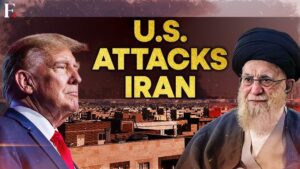
Soon that was followed by additional news. The United States also was attacking Iran. My wife and I weren’t about to trade watching more of the new season of Bridgerton for CNN or MSNBC, but by chance Trump’s address to the nation about the Iran attack was on just before we headed off to bed.
We wondered why Trump looked so strange, with a USA cap pulled so low, his eyes were almost completely hidden in shadow. One theory about this is “The hat is pulled low so that his eyes, which have looked tired of late, are hidden by the shadow.”
The short eight-minute speech was filled with the usual blatant Trump lies. As I noted a few days ago in a blog post about how eight months ago, Trump said Iran’s nuclear program was obliterated by a previous U.S. bombing that supposedly set back Iran’s nuclear ambitions by several years, how could the Trump administration now claim that Iran is just a week away from having enough nuclear material for a bomb?
That claim is false. But naturally last night Trump continued on with the lie that he had to go to war with Iran because it was close to getting a nuclear bomb that could reach the United States via an intercontinental ballistic missile. Which is another lie, because Iran doesn’t have an ICBM that can reach the U.S., and intelligence says that it will be 2035, if not longer, before Iran has this capability.
Maybe Trump recognized that his nuclear bomb lies don’t hold up under even mild scrutiny. So he focused on a goal of the war that up until now, Trump had denied was a priority of the United States: regime change in Iran. That’s why Trump brought up a litany of bad actions by Iran that went back almost fifty years.
Because Iran has fostered so many attacks against Israel and U.S. forces in the Middle East, Trump argued that the radical Islamic theocracy overseen by Ayatollah Khamenei needed to be removed from power. That actually makes a lot of sense — leaving aside the inconvenient truth that our Constitution says that only Congress can declare war on another country, and it is against international law to kill the leader of another country even if war has been declared,
(Remember when Putin fabricated a story that Ukraine had sent a swarm of drones to one of his residences in order to kill him, because that was so outrageous? This shows that the saying “all’s fair in love and war” isn’t true.)
There’s no doubt that Iran could be much better off after a regime change. I just read several essays in TIME magazine by Iranian dissidents about how wonderful it would be to have their country become a democracy with freedom of speech, women’s rights, and the other benefits of ditching extreme Islamic fundamentalism.
Hardly anyone is sad that Ayatollah Khamenei has been killed by an Israeli airstrike. No one who cares about the future of Iran, for sure. So it’s possible that even though Trump going to war with Iran was based on nuclear weapon lies, if the goal of regime change that leads to a genuine democracy could be achieved, Trump would deserve a lot of credit for attacking Iran.
We’re a long way from that sunny scenario, though.
Trump has called upon the Iranian people to rise up after the air strikes cease and overthrow their government. That’s asking a lot of Iranians. Not long ago they took to the streets in massive protests. The military and police killed tens of thousands of protesters, turning machine guns on their own citizenry. Trump seems to think that Iran is Venezuela 2.0. A quick strike by our armed forces, removal of the nation’s leader, willing cooperation with the United States by those now in charge of the country.
That’s unlikely to happen in Iran, a much larger and more diverse country. Sure, today there was cheering in the streets by crowds happy that Khamenei was dead. But cheers erupted in Iraq after the fall of Saddam Hussein, and the aftermath of that war went badly after it was won, even though we had “boots on the ground,” something unlikely to happen in Iran.
Anne Applebaum has an excellent piece in The Atlantic, “Trump has no plan for the Iranian people.” Excerpt:
The administration’s apparent lack of interest in the Iranian opposition adds a layer of surreality to the video that Trump posted early this morning. He called on the Islamic Revolutionary Guards Corps, the Iranian Armed Forces, and the police to “lay down your weapons.” But to whom should they surrender? He almost taunted the Iranian people to take charge. “Let’s see how you respond,” he said. “America is backing you with overwhelming strength and devastating force.”
But who is “you”? The civil-society and women’s-rights activists who want to build a rule-of-law society, with transparency, accountability, and independent courts? The ethnic minorities—Kurdish, Baluchi, Azerbaijani, and others—who want a decentralized state and more autonomy? The sometimes-fanatical supporters of a new monarchy, who have tried in recent months to push others to the sidelines? Breakaway groups inside the IRGC who might be interested in creating a military dictatorship?
The answer matters. As one opposition insider told me at the time of the previous American attack, the mere act of bombing Iran will not by itself create a stable regime. “If there was ever a fantasy that a leader would fly in under the wings of foreign aviators,” he told me, “that is definitely not going to happen.” Another Iranian activist texted me this morning: “This is one of the best days of my life, Anne; also I am very worried about what comes next.” (Both the opposition insider and the activist requested anonymity for fear of retaliation.)
The point is not that the U.S. should promote democracy for its own sake. The goal, rather, must be to help Iranians achieve normalcy. For the region to be at peace, Tehran must transform itself from the headquarters of an insurgency back into the capital of a country seeking to build peace and prosperity for its own citizens. A stable, law-abiding Iran will help build a stable, law-abiding Middle East. But in order to achieve that, Iran needs not a new dictatorship but self-determination and a pluralist government that respects basic rights. Right now, the Trump administration is not trying to build one.
Discover more from Salem Political Snark
Subscribe to get the latest posts sent to your email.