

Today the political world is abuzz about a lengthy two-part Vanity Fair story by Chris Whipple. Susie Wiles, J.D. Vance and the “Junkyard Dogs”:The White House Chief of Staff on Trump’s Second Term is Part 1. It’s available to everyone to read. Part 2, Susie Wiles Talks Epstein Files, Pete Hegseth’s War Tactics, Retribution, and More, requires a Vanity Fair subscription. I forked out $12 for a year-long digital subscription because I appreciated this groundbreaking story that cast new light on the Trump administration.
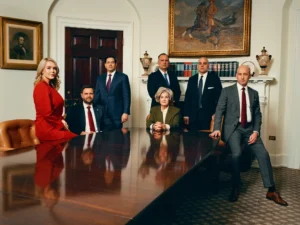
Since Trump and his cronies love to bitch and moan about “fake news” spread by the mainstream media, it’s amazing that Whipple was given such close access to Wiles, Trump’s Chief of Staff. This Vanity Fair photo accompanies Part 1. There Wiles is, the woman seated at the center of the table, with the White House press secretary, the Vice-President, the Secretary of State, and whatever Steven Miller calls himself part of the group.
Here’s excerpts from the story. The second paragraph of the first excerpt has gotten a lot of attention. I’ll include some explanatory context in the next excerpt.
Most senior White House officials parse their words and speak only on background. But over many on-the-record conversations, Wiles answered almost every question I put to her. We often spoke on Sundays after church. Wiles, an Episcopalian, calls herself “Catholic lite.” One time we spoke while she was doing her laundry in her Washington, DC, rental. Trump, she told me, “has an alcoholic’s personality.” Vance’s conversion from Never Trumper to MAGA acolyte, she said, has been “sort of political.” The vice president, she added, has been “a conspiracy theorist for a decade.” Russell Vought, architect of the notorious Project 2025 and head of the Office of Management and Budget, is “a right-wing absolute zealot.” When I asked her what she thought of Musk reposting a tweet about public sector workers killing millions under Hitler, Stalin, and Mao, she replied: “I think that’s when he’s microdosing.” (She says she doesn’t have first-hand knowledge.)
Wiles said Trump has “an alcoholic’s personality.” He “operates [with] a view that there’s nothing he can’t do. Nothing, zero, nothing.”…Rubio’s transformation was ideological and principled, she said: “Marco was not the sort of person that would violate his principles. He just won’t. And so he had to get there.” By contrast, she suggested, Vance had other motivations. “His conversion came when he was running for the Senate. And I think his conversion was a little bit more, sort of political.”…Wiles described Musk as something akin to a jacked-up Nosferatu. “The challenge with Elon is keeping up with him,” she told me. “He’s an avowed ketamine [user]. And he sleeps in a sleeping bag in the EOB [Executive Office Building] in the daytime. And he’s an odd, odd duck, as I think geniuses are. You know, it’s not helpful, but he is his own person.”
Did she ever ask the president, “ ‘Wait a minute, do you really want to pardon all 1,500 January 6 convicts, or should we be more selective?’ ”“I did exactly that,” Wiles replied. “I said, ‘I am on board with the people that were happenstancers or didn’t do anything violent. And we certainly know what everybody did because the FBI has done such an incredible job.’ ” (Trump has said his FBI investigators were “corrupt” and part of a “deep state.”) But Trump argued that even the violent offenders had been unfairly treated. Wiles explained: “In every case, of the ones he was looking at, in every case, they had already served more time than the sentencing guidelines would have suggested. So given that, I sort of got on board.” (According to court records, many of the January 6 rioters pardoned by Trump had received sentences that were lighter than the guidelines.) “There have been a couple of times where I’ve been outvoted,” Wiles said. “And if there’s a tie, he wins.”
“If somebody is a known gang member who has a criminal past, and you’re sure, and you can demonstrate it, it’s probably fine to send them to El Salvador or whatever,” Wiles told me. “But if there is a question, I think our process has to lean toward a double-check.” But as the usa.gov site itself notes, “In some cases, a noncitizen is subject to expedited removal without being able to attend a hearing in immigration court.”
Given voters’ anxiety about the cost of living, Wiles told me she thought Trump should pivot more often from world affairs to kitchen-table issues. “More talks about the domestic economy and less about Saudi Arabia is probably called for,” said Wiles. “They like peace in the world. But that’s not why he was elected.”
Perhaps most critical to Trump followers, though, is the fact that Trump indicated a willingness to release the files—and didn’t. As this article went to press, grand jury material from the Epstein records was due to be released in December. Wiles told me she underestimated the potency of the scandal: “Whether he was an American CIA asset, a Mossad asset, whether all these rich, important men went to that nasty island and did unforgivable things to young girls,” she said, “I mean, I kind of knew it, but it’s never anything I paid a bit of attention to.”
Wiles told me she’d read what she calls “the Epstein file.” And, she said, “[Trump] is in the file. And we know he’s in the file. And he’s not in the file doing anything awful.” Wiles said that Trump “was on [Epstein’s] plane…he’s on the manifest. They were, you know, sort of young, single, whatever—I know it’s a passé word but sort of young, single playboys together.”…Trump has claimed, without evidence, that Bill Clinton visited Epstein’s infamous private island, Little St. James, “supposedly 28 times.” “There is no evidence” those visits happened, according to Wiles; as for whether there was anything incriminating about Clinton in the files, “The president was wrong about that.”
In July, Todd Blanche, the deputy attorney general and Trump’s former lawyer, traveled to a Tallahassee, Florida, courthouse to interview Epstein’s longtime associate, Ghislaine Maxwell. Convicted on sex trafficking charges in 2021, she received a 20-year prison sentence. “It’s not typical, is it,” I asked Wiles, “to send the number two guy in the DOJ and the president’s former defense lawyer to interview a convicted sex trafficker?” According to Wiles, “It was [Blanche’s] suggestion.” Wiles said that neither she nor Trump had been consulted about Maxwell’s transfer to a less restrictive facility after Blanche’s visit. “The president was ticked,” according to Wiles. “The president was mighty unhappy. I don’t know why they moved her. Neither does the president.” But, she said, “if that’s an important point, I can find out.” (At press time, Wiles said she still had not found out.)
During my first visit with Wiles at the White House in November, Trump’s revenge tour against his domestic enemies was in full swing. So was his lethal campaign against Venezuelan president Nicolás Maduro, who, Trump was convinced, headed a powerful drug cartel. Over lunch, Wiles told me about Trump’s Venezuela strategy: “He wants to keep on blowing boats up until Maduro cries uncle. And people way smarter than me on that say that he will.” (Wiles’s statement appears to contradict the administration’s official stance that blowing up boats is about drug interdiction, not regime change.)
As of this article’s publication, at least 87 people had been killed in US strikes on boats in the Caribbean and eastern Pacific. The Washington Post reported that Hegseth had directed the US military to “kill everybody” in a strike on a boat; this was followed by a second strike that killed two survivors—a possible war crime. Hegseth said an admiral was responsible for the second strike. Congressional Democrats and even some Republicans were talking about calling hearings to investigate the matter. “Drug smuggling,” I pointed out to Wiles, “is not a death penalty offense, even if the president wishes it were.” “No, it’s not. I’m not saying that it is. I’m saying that this is a war on drugs. [It’s] unlike another one that we’ve seen. But that’s what this is.” “Obviously it’s a war declared only by the president and without any congressional approval,” I said. “Don’t need it yet,” Wiles replied.
In December, when asked about Trump falling asleep in Cabinet meetings, Wiles said, “He’s not asleep. He’s got his eyes closed and his head leaned back…and, you know, he’s fine.” What about Trump’s increasingly frequent verbal attacks on women, as when, in November, he snapped “Quiet, Piggy!” at a female reporter from Bloomberg? Wiles replied: “He’s a counterpuncher. And increasingly, in our society, the punchers are women.” Is Wiles really irreplaceable, as Rubio said? “Not patting myself on the back, but just recognizing the reality of this president at this time,” she said, “I’m just not [sure] who else could do this.”
“Will the president run for a third term?” I asked in November. “No,” she said and then added, “But he sure is having fun with it.” Wiles said he knows it’s “driving people crazy.” “So that’s why he talks about it,” I said. “Yeah, 100 percent.” “Would you say categorically no, and that the 22nd Amendment rules out [a third term]?” “I do. Yeah. And I’m not a lawyer, but based on my reading of it, it’s pretty unequivocal.” “And has he told you that in so many words?” “Yes. Oh, a couple times, yeah.” And then she went on. “Sometimes he laments, ‘You know, gosh, I feel like we’re doing really well. I wish I could run again.’ And then he immediately says, ‘Not really. I will have served two terms and I will have gotten done what I need to get done, and it’s time to give somebody else a chance.’ So, you know, any given day, right? But he knows he can’t run again.”
Back in March, on the 56th day of Trump’s presidency, I’d asked Wiles: “Do you ever go in to Trump and say, ‘Look, this is not supposed to be a retribution tour? ’” “Yes, I do,” she’d replied. “We have a loose agreement that the score settling will end before the first 90 days are over.” In late August, I asked Wiles: “Remember when you said to me months ago that Trump promised to end the revenge and retribution tour after 90 days?” “I don’t think he’s on a retribution tour,” she said. “A governing principle for him is, ‘I don’t want what happened to me to happen to somebody else.’ And so people that have done bad things need to get out of the government. In some cases, it may look like retribution. And there may be an element of that from time to time. Who would blame him? Not me.” “So all of this talk,” I said, “about accusing Letitia James of mortgage fraud….”“Well, that might be the one retribution,” Wiles replied.
As the 2026 midterm elections approach, the stakes for Trump and his chief of staff couldn’t be higher. Trump’s second term has been more consequential than his first. He could leave office as a transformational president who sealed the southern border, passed major tax cuts, brought peace to Gaza, and re-created the GOP in his image. Or he could pursue reckless vendettas, shred democratic guardrails, and end up in the crosshairs of Democrat-led investigations. Either way, Wiles may be the thin line between the president and disaster. As one former GOP chief put it, “She may be more consequential than any of us.”
Discover more from Salem Political Snark
Subscribe to get the latest posts sent to your email.