

President Trump wants a Nobel peace prize. Well, so do I.
And I think my plan for negotiating an end to the war between Ukraine and Russia is better than Trump's. Of course, the bestowers of Nobel prizes would have to overlook the minor (in my view) problem that I have absolutely no contact with Ukraine or Russia, so I'll be conveying my plan to Zelensky and Putin via mental telepathy.
If my plan is adopted in whole or in large part by the warring parties, that will prove to the Nobel prize committee that I am most deserving of the Peace Prize. So, behold:
Basic Assumption: Russia invaded Ukraine. Russia started the war in 2022 after taking over Crimea and portions of eastern Ukraine for no reason other than Putin's egotistical desire to go down in history as having been responsible for Russia regaining control of parts of the former Soviet Union. This is well stated by Timothy Snyder in his substack post today, where I got this idea.
So Russia shouldn't get any special treatment in negotiations. Putin is in the wrong. Zelensky is in the right. Sure, realities "on the ground," as the saying goes, need to be taken into account, since Russia has military control of about 20% of Ukraine. [Word usage note: I can't stand the frequent use of on the ground, as I complained about in a 2021 blog post.]
These are the core components of my Ukraine war peace plan, ranging from most crucial, or essential, to less crucial, or desirable.
(1) Ukraine must have an ironclad security guarantee. Putin can't be trusted. He's a trained KGB agent who kills his political opponents. His promise, based on what we know about what transpired at last Friday's Alaska summit between Trump and Putin, that a commitment will be added to the Russian constitution, or whatever it's called, prohibiting the re-invasion of Ukraine or the invasion of another European country by Russia means absolutely nothing.
There has to be some sort of tripwire that will cause European and American military forces to respond with overwhelming force against any move by Russia to rekindle its war with Ukraine after a peace deal goes into effect. This has to be ratified by the European nations responsible for the security guarantee and enshrined into law by the United States congress and President Trump.
(2) Ukraine can't be forced to give up any territory not currently controlled by Russia. Ukraine's constitution prevents surrendering any of its territory to another nation. So there's no way Ukraine is going to go along with a peace plan that declares part of Ukraine is now legally part of Russia. But the de facto (as opposed to de jure) control of some Ukrainian territory by Russia will have to be part of a peace deal.
It makes sense to have this be the current battlefield lines of control. The Ukraine war has settled into a sort of trench warfare where neither side can make major gains. The widespread use of drones is a big reason for this, since any movement of soldiers or vehicles is almost instantly known by the other side, with drones dropping explosives on the advancing forces.
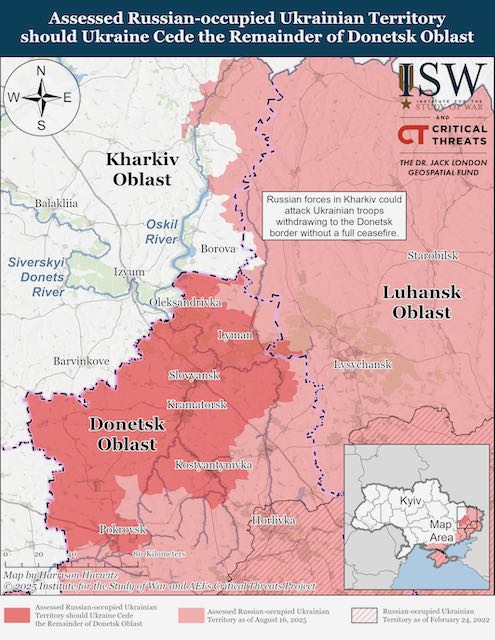
Putin says he wants control of the entire Donbas region (Luhansk and Donetsk oblasts, or provinces), even the parts that Russia does not currently control. The map above from a recent post by the Institute for the Study of War shows what Russia currently controls, and wants to control. The light orange is what Russia already controls. The dark orange is what Putin dreams of controlling — which would be a nightmare for Ukraine.
The reasons why are described in this passage from the ISW post.
ISW continues to assess that a potential Ukrainian withdrawal from Donetsk Oblast would degrade Ukraine's defensive capabilities and defense industrial base (DIB) and put hundreds of thousands more Ukrainian civilians under Russian occupation. Ukraine would require robust international security guarantees and the immediate deployment of an international peacekeeping contingent to deter future Russian aggression.
ISW continues to assess that surrendering currently unoccupied areas of Donetsk Oblast to Russia would position Russian forces extremely well to renew their aggression against Ukraine on much more favorable terms, having avoided a long and bloody struggle for this territory and given Russia the opportunity to build up manpower and weapons stocks.
ISW previously noted that allowing Russia to occupy the remainder of Donetsk Oblast would concede Ukraine’s fortress belt to Russian forces, and this fortress belt also includes significant DIB infrastructure. Russian forces have notably been unable to advance to or envelop the fortress belt since Fall 2022. The Russian military command would almost certainly work to rapidly establish lasting positions throughout the fortress belt and utilize the fortress belt's DIB for military production if Ukrainian forces withdraw from their positions in Donetsk Oblast.
ISW also previously noted that the Donetsk Oblast border area is naturally poorly suited to act as a robust defensive line due to its few settlements, open fields, and natural obstacles such as the Oskil and Siverskyi Donets rivers. A Ukrainian withdrawal across the Donetsk Oblast border would therefore also require the deployment of a robust international peacekeeping force and large-scale investment in infrastructure compatible with a large-scale, long-term ceasefire monitoring mission to prevent future Russian aggression. The absence of a full ceasefire on the frontline and regarding long-range strikes would likely preclude the deployment of this international force, however.
(1) and (2) seem to be the crucial pieces of the peace puzzle for Ukraine. These are some of the remaining pieces that would be desirable, but not essential.
(3) Ukraine is able to use for reconstruction approximately $350 billion in frozen Russian assets that the European Union controls. Putin would freak out about this, and it faces some legal hurdles. At the least, Ukraine should be able to continue using the interest generated by these assets.
(4) Ukraine agrees not to seek NATO membership. Zelensky wouldn't like this, but if there are ironclad security guarantees against Russian aggression, that would be almost as good as NATO membership.
(5) Russia agrees to return as many Ukrainian children as possible. It's disgusting that Russia has kidnapped many thousands of Ukrainian children who now are living in Russia. Ukraine should push hard to have the children returned, but this shouldn't stand in the way of a peace deal.
Discover more from Salem Political Snark
Subscribe to get the latest posts sent to your email.