

We all want to be heard, listened to, taken seriously. But when it comes to commenting on a development project that falls under land use, zoning, and similar sorts of rules, some usual tendencies should be kept in check.
Like getting too emotional. And being too general. Both of which I’m prone to, as most of us are.
I understand why so many people oppose the Oakline at Mill Creek data center planned to be built in the Mill Creek Corporate Center. Often this stems from a hatred of AI, artificial intelligence, and from horror stories regarding data centers elsewhere in the country with extreme noise, water use, electricity demand, and other negative stuff that have gotten national headlines.
That may motivate someone to oppose a Salem data center. However, it won’t be useful in trying to stop the data center. Emotions and generalities count for exactly zero in these sorts of development decisions.
Pay attention to what Kristin Retherford says in a Salem Reporter story by Joe Siess, “Salem’s proposed data center faces months of review. Here’s how you can weigh in.” Retherford is the City of Salem’s Community Planning & Development Director.
Retherford offered specific guidance on how to make a public comment that actually carries weight.
The city can only legally consider comments tied to its own review criteria, not general opinions about data centers or artificial intelligence, she said. Retherford was direct about this. Telling the city you don’t like data centers, or that Salem doesn’t need one, won’t factor into the decision because the zone already allows for them.
“What will count is comment that engages with the city’s specific findings on things like traffic, water use and environmental impact, and argues those findings don’t adequately address what code requires,” Retherford said. “For public comment to have the most oomph that it could, looking at the findings and the criteria and commenting based on that has much more substance than an opinion.”
The practical implication is that once the application is posted, residents who want to engage should read the staff findings and look for places where they think the city’s analysis is incomplete or wrong, then write comments specifically to those points. That kind of comment can also become the basis for an appeal.
The first opportunity to comment on the Salem data center proposal is next Monday’s (July 27) City Council meeting. Here’s a link to the agenda for the meeting. This info is at the beginning of the agenda.
Monday, July 27, 2026 06:00 PM Loucks Auditorium / Salem Public Library
This meeting is being conducted both in-person and remotely and allows remote attendance by the governing body, when requested. Interested persons may attend the meeting in Loucks Auditorium at Salem Public Library or view the meeting in real-time on the City of Salem YouTube Channel, thanks to a partnership with CC:Media. Comcast Cable subscribers can watch on CC:Media Channel 21.Please submit comments on agenda items by 5:00 p.m., or earlier, on the day of the meeting at cityrecorder@cityofsalem.net.
If attending the meeting remotely, public comment and testimony may be provided during the meeting via Zoom. Remote attendees must pre-register between 8:00 a.m. and 3:00 p.m. on the day of the meeting using this link: https://www.cityofsalem.net/comment-at-council
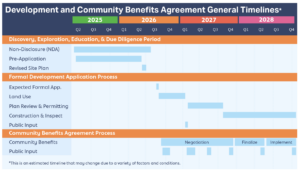
On pages 37-126 of the agenda there’s detailed information about item 5.1 that deals with the data center. The City of Salem web site also has a section devoted to the data center. This graphic shows the lengthy timeline the project is expected to follow.
Today I submitted a comment to the City Recorder for the July 27 City Council meeting data center agenda item. Here it is.
I support a fair and unbiased consideration of the Verrus proposal for a data center on the Mill Creek Corporate Center property. The instant opposition to the data center bothers me, as it is largely —and sometimes completely — untethered from the facts of this particular proposal. Note: particular.
Opponents conflate opposition to AI in general, and data centers in general, with the particular circumstances of the Verrus proposal. Naturally much work remains to confirm that the claims Verrus is making for a “kinder and gentler” data center (less noise, less water use, less electricity requirement, etc.) stand up under close scrutiny.
But attempts to paint the Oakline at Mill Creek with the broad brush of horror stories of poorly designed and sited data centers in other parts of the country ignore the unique characteristics of this particular proposal.
The AI genie is not going to be put back into a technological bottle. AI will continue to develop, in some ways positively, in some ways negatively. The computing resources needed to train and maintain AI models like ChatGPT and Claude may lessen over time, as Chinese models seem to have demonstrated. In that case it will be Verrus who will have overbuilt, and it will be Verrus who will absorb that financial burden.
However, Verrus seems to be wise in planning a second generation data center that is less costly to operate than first generation data centers. Opponents fret that so far Verrus hasn’t built a data center akin to the one planned for Salem.
Well, we here in Salem should look upon this as an opportunity. If the design of Oakline at Mill Creek proves to be an advance, Salem will become a mecca of sorts for those looking to build similar data centers. We will have helped advance wise AI technology. So let’s look forward optimistically to a review of the Verrus proposal, rather than rejecting it for spurious reasons.
Sincerely, Brian Hines
Discover more from Salem Political Snark
Subscribe to get the latest posts sent to your email.