

Political ambition creates strange bedfellows.
Today the two main candidates for Oregon governor in November’s election, Democrat incumbent Tina Kotek and Republican state senator Kristine Drazan, both expressed their support for a statewide moratorium on data centers — even though they’d previously expressed reservations about this.
Well, that’s what happens when polling shows that most Oregonians are on board with a moratorium. A story in today’s Oregonian by Mike Rogoway says:
Gov. Tina Kotek and her Republican opponent, Sen. Christine Drazan, both called for statewide moratoriums on data centers Tuesday, converging on the same position within hours of each other after years of more cautious stances on the hot-button issue.
The change comes as public sentiment sours on the industry ahead of the November election.
…An independent poll this summer by DHM Research found that two-thirds of Oregon voters support a moratorium on new data centers and that three-quarters want to halt tax breaks for the industry. Opposition spans partisan lines, though Democrats and nonaffiliated voters are more receptive to restrictions than Republicans.
It’s easy for Kotek and Drazan to come out in favor of a statewide moratorium because the governor doesn’t have the authority to establish one. So whoever wins in November will have to urge the Oregon legislature to pass a moratorium bill in the 2027 session, which begins January 11 and runs until June 19.
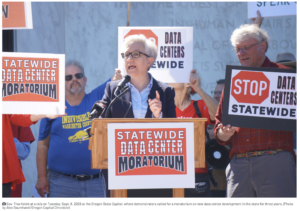
All Governor Kotek could do at the moment is instruct state agencies to give a cold shoulder to data centers, as described in an Oregon Capital Chronicle story by Alex Baumhardt.
Roughly 100 people showed up outside the Oregon State Capitol on Tuesday to call for a three-year pause on new data center development in the state.
Among them was Gov. Tina Kotek, who expressed support for the demonstrators — a coalition of environmental, public health, farm and social advocacy groups — but who stopped short of endorsing the length and breadth of the pause they desired.
“I support a moratorium until we make sure that any data center development is done on our terms,” she said.
At the event, she unveiled a roughly one-year pause on approvals for any requests to develop data centers on state land or in state buildings. The order will “immediately pause unapproved requests for easements, rights-of-way, leases, rentals, land-use permits and sales or transfers of state-owned property for data center projects,” according to a news release from Kotek’s office.
“Today, I’m taking the next step by directing state agencies to immediately stop work on any state owned land transaction connected to a new data center. Not just here in Salem, but everywhere in Oregon where the state owns the land,” she said.
The pause would last until July 1, 2027 or until “until statewide action from the Governor’s Office or the Legislature directs otherwise,” according to the release, where Kotek also insists that the state “currently lacks authority to enact a statewide moratorium on data center development.”
The application by Verrus for a data center here in Salem, Oakline at Mill Creek, recently was deemed incomplete by city officials, so hasn’t even begun to be reviewed. It will be interesting to see if Oakline at Mill Creek can be a model for a “kinder and gentler” data center that doesn’t produce excessive noise, electricity use, water consumption, and other nasty stuff, as many data centers do.
Verrus talks a good game on its Salem web site, but talk is cheap. I’m hoping that both opponents and proponents of Oakline at Mill Creek will keep an open mind and accept that AI, artificial intelligence, is here to stay. The AI genie can’t be put back in the bottle. All humanity can do is try to guide the course of AI development in as wise a direction as possible.
Currently, large data centers filled with complex computer equipment are necessary to create, maintain, and improve AI models. Whether that always will be the case is an open question. I suspect that AI will evolve in the direction of more efficiency and smaller scale — much as centralized mainframe computers were supplanted by widely distributed desktop computers, and now by handheld computers known as smartphones.
Likely today’s controversy over data centers will fade away before too long, to be replaced by other AI controversies such as AGI, artificial general intelligence, and not-so-minor worries about AI’s going rogue and turning on their human creators.
Discover more from Salem Political Snark
Subscribe to get the latest posts sent to your email.