

Though I’m not a Buddhist, I like the notion of a Middle Way — which traditionally avoids the extremes of asceticism and sensual indulgence. After all, most things in life seem well suited to moderation, a Goldilocks approach to life.
Goldilocks went inside. First she tasted the porridge of the great, huge bear, and that was far too hot for her. And then she tasted the porridge of the middle bear, and that was too cold for her. And then she went to the porridge of the little, small wee bear, and tasted that. And that was neither too hot nor too cold, but just right; and she liked it so well, that she ate it all up.
So what’s just right when it comes to the national debate over AI and data centers?
Which has come big time to us here in Salem, now that Verrus has filed an application to build a data center at the Mill Creek Corporate Center. Community opposition spurred the city council to initiate the process needed to establish a moratorium on data centers, though it appears that this likely wouldn’t apply to Verrus, since their application was submitted three days before the city council met to discuss a moratorium.
The Trump administration is an avid supporter of AI and data centers, so they favor laissez faire policies that border on the extreme of anything goes. Avid opponents of AI and data centers want to see them stopped in their tracks, or at least slowed to a snailish crawl — basically an everything stops attitude.
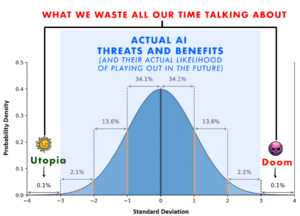
Me, I’m in the middle. Along with Daniel Jeffries, who wrote “The Middle Path for AI” that included the provocative figure above.
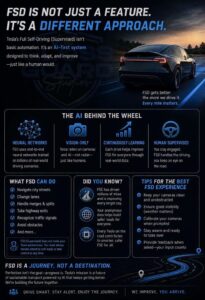
I find AI models like Claude, ChatGPT, and Gemini to be highly useful, a real time saver that’s far superior to the Googling I’d do in pre-AI days. And I’m a huge fan of my Tesla’s Full Self-Driving (Supervised) capability. That’s what led me to lease a Model Y Juniper about nine weeks ago. I’ve been driving it, or rather it’s been driving me, via FSD 95% of the time.
This graphic shows how Tesla’s FSD is AI on wheels.
AI already is bringing many benefits such as self-driving cars and trucks. Also, many problems. This includes the negative impacts of data centers that are needed for the creation, maintenance, and improvement of AI applications — along with a host of future potential problems, such as massive job losses caused by AI, and the scariest problem of all, superintelligent AI becoming the master of humanity rather than our servant.
In the August 10, 2026 issue of The New Yorker, Evan Osnos made some wise observations about AI and data centers in his article, “The Future, Made in China.” I’ll share a PDF file.
The Future, Made in China | The New Yorker
Here’s part of what Osnos said:
The engineering state [of China] can churn out an electric car every seventy-six seconds, but that carries you only so far if people are so alienated that they decline to bring children into the future being built for them. The Party wants A.I. entrepreneurs who can dazzle the world, but it also wants the power to decide where they can go and what they can become.
The U.S. has a different weakness. So far, the dystopian uses of technology have come less from government facial-recognition systems than from a handful of ultrapowerful companies that exploit data to increase their control over people’s lives: insurers that use A.I. to decide which treatments to cover; retailers that deploy “surveillance pricing” to raise costs according to a customer’s location, habits, and urgency. But the distinction is eroding, as private defense contractors help merge domestic law enforcement, immigration, and national security into an interlocking apparatus.
Even in areas where machines may genuinely make life better, the decisions are being made in secrecy. Waymo reports better safety records than human drivers, but autonomous-vehicle companies have resisted public scrutiny. When Senator Ed Markey asked seven major companies how often remote human operators had to guide vehicles through difficult situations, they refused to answer, with several citing “confidential business information.”
The more centralized the system, the further an error can travel. In March, when Baidu, which operates self-driving taxis in more than a dozen Chinese cities, suffered an outage, cars halted on busy highways. We are almost certainly better off without humans at the wheel of cars and trucks, but history warns that we should not let engineers make these decisions alone. The country best equipped to help its people will not be the one that simply races to insinuate A.I. into every aspect of civic life; more likely, it will be the one that shields decisions about deployment from the distortions of ideology and corruption, that finds ways to distribute both the rewards and the losses from A.I., and that makes people feel they have a voice in their future.
America is not functioning well these days, but its political system, by design, gives the public more power to fix problems—if they choose to fix them. As Wuttke put it, “The United States has a knack of going down in flames and then rejuvenating. China does not.” The advantage might go to the side that can face its problems most candidly. “You can live in an alternate reality in China, in Russia, or in the United States,” he said. “That is always a dangerous proposition, because you might miss the signals of history coming your way.”
This sentence bears repeating: “The country best equipped to help its people will not be the one that simply races to insinuate A.I. into every aspect of civic life; more likely, it will be the one that shields decisions about deployment from the distortions of ideology and corruption, that finds ways to distribute both the rewards and the losses from A.I., and that makes people feel they have a voice in their future.”
Salem can contribute to this outcome by conducting a reasonable, fair, factual, transparent review of the proposed data center. AI and data centers can be highly beneficial if they are regulated wisely. They shouldn’t be given free rein, and they shouldn’t be controlled too tightly. There’s a Middle Way, and I’m confident Salem can navigate it.
Discover more from Salem Political Snark
Subscribe to get the latest posts sent to your email.