

My approach to politics, and to life itself, is reflected in a basic principle of Tai Chi — which I’ve practiced for about twenty years. Yang follows yin; yin follows yang. So two yang moves in succession is a Tai Chi no-no.
Expressed in plain English, the notion is that when strength meets strength, a battle ensues. Which doesn’t mean that conflict should be avoided. It means that a forceful attack shouldn’t be met with an equally forceful counterattack, but with a redirecting of the opponent’s energy, a softness that deflects hardness, allowing for a more favorable outcome than, as they saying goes, meeting fire with fire.
Because meeting fire with water is a better approach.
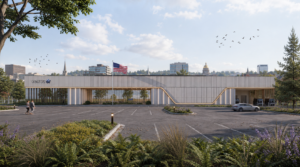
Last night the Salem City Council held a special meeting about a proposed moratorium on data centers. Once again, just as occurred the preceding Monday at a regular council meeting, a large number of people turned out to voice their opinions about the data center proposed by Verrus to be built at the Mill Creek Corporate Center.
Most of the testimony was opposed to the data center. Some was in favor of it, mostly from construction workers, electricians, and others in trades that would benefit from the data center’s construction. Once again, John Poole created a highly useful and impressive compendium of both a video summary of in-person testimony presented via public comments along with other parts of the council proceedings, and of a summary of advance written testimony.
Poole was able to do this so quickly because his extensive software skills were aided by ChatGPT and Codex, a coding agent within ChatGPT. So while Poole is opposed to the data center, he is using an AI model to assemble information helpful to both opponents and proponents of the proposed data center.
Personally, I’m also a fan of AI models (my favorite is Claude), using them for everyday questions about all kinds of subjects. (Today Claude responded to a question I had about the Nordic Naturals algae oil I use to get omega 3 in lieu of fish oil, since I’m a vegetarian who doesn’t eat fish or meat.) Since data centers are used to develop and maintain AI models, I figure it would be hypocritical for me to oppose AI data centers in general.
But I can oppose data centers that use excessive amounts of water and electricity, are excessively noisy, and are built on farm or forest land, or in close proximity to residential neighborhoods.
What concerns me about much of the opposition to the Verrus data center proposal isn’t that opponents are asking pointed questions, but that they seem to have made up their minds that no matter what the answers are, a Salem data center shouldn’t be built. Several weeks ago I wrote, “Data center proposed for Salem has both potential benefits and problems.” I started that blog post with:
Like most things in life of this sort, a data center proposed to be built on 75 acres in Salem’s Mill Creek Corporate Center is more complex than avid proponents and opponents are willing to admit.
Depending on who is speaking for or against the project, Oakline at Mill Creek would either be a boon to Salem’s economy and tax base, or a giveaway to a giant corporation that will wreak havoc on its neighborhood and the environment.
I feel the same way now. Not enough is known about Oakline at Mill Creek for me to conclude that the data center is a good idea, or a bad idea. I’ve heard lots of opinions from both opponents and proponents of the data center, but solid facts are lacking at this point.
My main firm conclusion, expressed a few days ago, is that city manager Krishna Namburi and other city officials screwed up big-time by signing a nondisclosure agreement (NDA) with Verrus on April 10, 2025, then spent the next 15 months working with Verrus on pre-application activities outside of the public eye, due to the NDA.
This was managerial malpractice.
It tilted the playing field in favor of Verrus, who had a year and a quarter to plan away with the assistance of city staff, facing zero opposition from the public because no one other than Verrus and city officials knew about the data center proposal. So last Friday Verrus could file an application with the City of Salem, beating the clock by three days on a data center moratorium that was unanimously approved by the city council last night.
Regarding yin and yang, Verrus had 15 months all to itself to plan the data center with city officials — a big hunk of assertive yang energy. Meanwhile, the public was still and silent, being clueless about the existence of the Verrus proposal — a big hunk of passive yin energy.
It’s been completely appropriate for public outrage at the data center to surface and be expressed after the NDA was belatedly set aside on July 8, 2026. Also, for public support of the data center to surface and be expressed. But now I feel that it is time for both opponents and proponents of the data center to chill out a bit as the moratorium wends its way through a lengthy required public process that will take several months.
I want to hear the details of Verrus’s plans for the data center. Not the broad brush PR stuff on the Oakline at Mill Creek web site. Technical stuff that unbiased experts can review and tell us ordinary citizens whether it seems that Verrus’s claims of a “kinder and gentler” second generation data center hold up under close scrutiny, or are corporate B.S.
I’m not asking for blind trust from either opponents or proponents of the data center. I’m asking for open minds, notably including the members of the city council — who I suspect are going to be tempted to jump on the Stop the Data Center bandwagon because this appears to be the current community consensus. Maybe that will turn out to the correct stance.
But as more facts emerge, maybe it won’t. So let’s all try to keep our minds as open as possible, even as we advocate for what we believe is the correct thing to do at any given moment.
Discover more from Salem Political Snark
Subscribe to get the latest posts sent to your email.
Yin-Yang. Good piece, but for me it is a time for Yin, respectfully.
This reminds me of the cyanobacteria outbreak in our water supply years back when the city decided it was best to not tell us that it was happening.