

When I checked my iPhone for the latest news upon waking this morning, my mood instantly brightened. Yay! The Supreme Court has ruled that most of Trump’s tariffs were illegal. And not by a narrow 5-4 margin, by a 6-3 margin, so three Trump-appointed justices ruled against him.
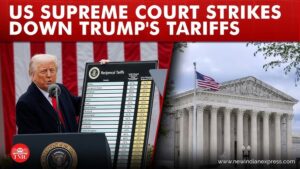
Up until now the Supreme Court has mostly been allowing Trump to pursue his authoritarian dreams with minimal pushback. But this was a big rejection of unfettered presidential power.
Even three conservative Supreme Court justices realized that the Constitution gives Congress the power of taxation, and tariffs are a tax paid by the American companies that import goods subject to tariffs, and also by consumers who purchase those goods if, as usually happens, a company increases its prices to cover some or all of the cost of the tariff it now has to pay.
Ever since Trump announced his first round of crazily high tariffs (based on lies) against most of the world in April 2025, they’ve been unpopular with Americans. Tariff unpopularity has continued into 2026. A Washington Post story, “Trump loses favorite negotiating tool he touted to make peace and money,” says:
Americans have broadly disapproved of Trump’s handling of tariffs since he first introduced them in April. Sixty-four percent of respondents in a Washington Post-ABC News-Ipsos poll released Friday disapprove of Trump’s handling of tariffs, ratings nearly identical to April polling despite Trump’s efforts to sway public opinion on the issue.
Tariffs also emerged as one of the first issues that fractured Trump’s fraying coalition, after his April announcement of the taxes prompted wild swings in the markets. Some of the corporate titans, podcasters and even Republican lawmakers who served as Trump’s biggest boosters during the campaign publicly criticized the policy. A legal center funded by wealthy conservatives backed the lawsuit against the tariffs.
So the Supreme Court decision offered Trump and the GOP an off-ramp prior to the November midterm election to reduce widespread, and totally justified, public concern that tariff taxes were costing the average household $1,000 to $2,000 a year, along with being an excessive use of presidential power that was making the United States a pariah among countries that used to be strongly in the American camp.
Not surprisingly, today Trump failed to take advantage of that off-ramp. Instead, he announced that he’d be zooming right back onto the Trump Tariff Freeway, even though it now contained many more obstacles for Trump to inflict tariffs on other countries.
Apparently he does have Section 122 authority to impose the 10% worldwide tariff on goods imported to the United States that Trump announced today, even though no president has ever used that part of the law to impose tariffs. Section 122 only allows for tariffs to be imposed for 150 days, after which approval by Congress is needed for an extension.
It’s hard to see Congress doing that. The 150 days, five months, brings us to mid-July, uncomfortably close to the November midterm election for Republicans to feel good about extending a 10% tariff tax on imported goods, especially since affordability will be a focus of midterm campaigns. This is why Politico ran a story today titled “Republicans quietly celebrate the demise of tariffs. That relief might not last.”
Republicans quietly breathed a collective sigh of relief when the Supreme Court struck down President Donald Trump’s sweeping tariffs on Friday — but that feeling may prove fleeting.
The court’s decision to upend Trump’s global tariffs comes as affordability concerns and the cost of living continue to galvanize voters ahead of the midterms. Many free trade-friendly Republicans spent the past year worrying that the tariffs would drive prices higher, destabilize the economy and hurt their hopes of hanging onto control of Congress this November.
“It’s very possible that the Supreme Court just threw Trump’s economy a life preserver, and the president is refusing it and demanding an anchor. These tariffs economically have not played well into the affordability narrative,” said Matthew Bartlett, a Republican strategist and former Trump State Department official. “It just has not been helpful — full stop.”
Trump’s hard line on tariffs has proven particularly difficult for some GOP candidates to navigate in battleground states where manufacturing and agricultural industries have been hit the hardest by the trade measures. Several of Trump’s allies in farm country and Republicans encouraged him to pump the brakes Friday and reassess his path forward.
But the president’s announcement of a 10 percent global tariff immediately after the ruling had them back on their guard.
“We have very powerful alternatives,” Trump said in a press conference Friday afternoon, announcing he will sign the new tariff under Section 122 of the Trade Act of 1974 – and rejecting the possibility of legislating a new measure through Congress. “I don’t need to,” he said. “It’s already been approved.”
…It’s a long time until November’s midterms. But in battleground races where tariffs pinched the most, the recent memory of trade adventurism and the ongoing dissatisfaction with the current state of the economy could prove fatal for Republicans, said Wisconsin-based GOP strategist Craig Peterson.
“In this last year with all the tariffs and increased costs, it’s going to take a little while for folks to forget about that,” Peterson said, noting Election Day is less than nine months away. “That’s not real long, unfortunately, for the Republicans.”
Discover more from Salem Political Snark
Subscribe to get the latest posts sent to your email.