

I’ll say this as non-gently as possible. Anyone who takes medical advice from Donald Trump, Robert F. Kennedy Jr., or anyone else in the Trump administration is a fucking idiot!
Okay, not you, if you’ve done what I said you shouldn’t do, because I adore each and every one of my blog visitors. I’m just talking about everybody else who listened to Trump’s incoherent recent remarks about how pregnant women shouldn’t take Tylenol (acetaminophen) even if they have a high fever, because Tylenol causes autism.
Both of those statements aren’t true.
But you shouldn’t take medical advice from me either. So I’m going to share some links on this subject from reputable sources, along with excerpts, and you can decide whether you want to believe medical experts or Trump and RFK Jr., his Health and Human Services secretary.
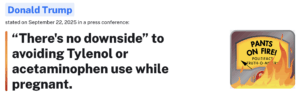
PolitiFact weighed in on Trump’s claim that there’s no downside to pregnant women “toughing it out” if they have a high fever.
His advice has no clear basis in research and contradicts longstanding science and medical guidance. And there are downsides to avoiding acetaminophen, the active ingredient in Tylenol, when it is needed. Untreated fever during pregnancy can harm a mom and baby, medical experts warn. Untreated pain is a drawback, too.
Trump’s advice is based on the unproven idea that acetaminophen use during pregnancy increases a child’s risk of autism — a stance that he and Robert F. Kennedy Jr., the longtime anti-vaccine activist Trump tapped as health secretary, touted throughout their address.
Although some studies have found that children exposed to acetaminophen during pregnancy were more likely to have autism symptoms or be diagnosed with autism, other studies found no such association. Association is not the same as causation. That means that research showing an association between Tylenol and autism doesn’t mean the medication caused autism.
The U.S. Food and Drug Administration’s Sept. 22 press release on the topic said as much.
“It is important to note that while an association between acetaminophen and neurological conditions has been described in many studies, a causal relationship has not been established and there are contrary studies in the scientific literature,” it said. “It is also noted that acetaminophen is the only over-the-counter drug approved for use to treat fevers during pregnancy, and high fevers in pregnant women can pose a risk to their children.”
In another post, PolitiFact focused more on the unproven assertion that Tylenol causes autism.
Medical professionals and researchers — not just brands like Tylenol that sell acetaminophen products — have long advisedpregnant patients that Tylenol is the safest option to reduce fever or pain.
Maternal and prenatal care groups, including the American College of Obstetricians and Gynecologists and the Society for Maternal-Fetal Medicine, support the use of acetaminophen during pregnancy — and have reaffirmed their support in recent days.
The Trump administration’s recent effort to discourage the use of Tylenol during pregnancy rests on the unproven idea that acetaminophen use during pregnancy increases a child’s risk of autism — and it’s based on conflicting science, experts told PolitiFact.
Some studies have found that children exposed to acetaminophen during pregnancy were more likely to have autism symptoms or be diagnosed with autism, but other studies found no such association. Association is not the same as causation, however. All that to say: Research showing an association between Tylenol and autism doesn’t prove the medication caused autism.
As the U.S. Food and Drug Administration announced Sept. 22 it had “initiated the process” to change acetaminophen labels, it also acknowledged the drug isn’t a proven cause of autism.
“It is important to note that while an association between acetaminophen and neurological conditions has been described in many studies, a causal relationship has not been established and there are contrary studies in the scientific literature,” it said.
Finally, there’s one more detail to keep in mind: Avoiding Tylenol during pregnancy might have negative consequences.
Research has linked untreated fevers during pregnancy to an increased risk of birth defects and other pregnancy complications, particularly if they occur during the first trimester. Untreated pain can lead to maternal depression, anxiety and high blood pressure.
“Maternal fever, headaches as an early sign of preeclampsia, and pain are all managed with the therapeutic use of acetaminophen, making acetaminophen essential to the people who need it,” said Dr. Steven J. Fleischman, American College of Obstetricians and Gynecologists president. “The conditions people use acetaminophen to treat during pregnancy are far more dangerous than any theoretical risks and can create severe morbidity and mortality for the pregnant person and the fetus.”
Lastly, a New York Times opinion piece analyzed the rise in autism diagnoses in “Autism Has Always Existed. We Haven’t Always Called It Autism.”
It’s easy to forget how recently autism became a common diagnosis and a household word. It’s easy to forget how little researchers and clinicians knew about developmental disorders, how we would marginalize people with the symptoms we now call autism, stigmatize them and their families and deny them an education. Without knowledge of that past, we risk making policy decisions that will stall scientific and social progress.
What we have learned from dozens of rigorous studies is that, in contrast to claims Mr. Kennedy has made, vaccines do not cause autism. We know that more than 100 genes are associated with autism, which interact not only with one another but also with individuals’ environment and experience throughout their lifetime. The neurogeneticist Stanley Nelson once said, “If you had 100 kids with autism, you could have 100 different genetic causes.”
Researchers increasingly believe the search for a cause of a singular “autism” is misguided. There are autisms, rather than just autism. The diversity in symptoms, the severity of symptoms and the range of biological contributors are simply too large to be reduced to one uniform disorder. The neurobiology is too complex for easy explanations.
The more we learn, the more we realize that scientific answers to the question “What causes autism?” or even “What is autism?” will take a long time to unravel, no matter how quickly a government official wants them.
…President Trump claimed on Monday that “since 2000, autism rates have surged by much more than 400 percent.” But the definition of autism has changed so much that comparing diagnostic rates from different eras is misleading.
When “infantile autism” was first introduced into the American Psychiatric Association’s diagnostic manual in 1980, it was defined so narrowly that few children qualified. But by the time Isabel was diagnosed, the concept had been broadened to “autistic disorder,” with much greater flexibility in symptoms and age of onset. Core traits like “pervasive lack of responsiveness to other people” were broadened to include looser, more subjective descriptions, such as preferring solitary play.
Discover more from Salem Political Snark
Subscribe to get the latest posts sent to your email.