President Donald Trump is pursuing an agenda that would add trillions of dollars to the soaring national debt, ignoring warnings from Wall Street, Republican deficit hawks and his outgoing cost-cutting champion.
Though Trump ran for office in part on pledges to slash the size of the federal government and rein in the debt, his record so far has been less fiscally disciplined.
His administration this week asked Congress to cancel a little more than $9 billion in spending in the current fiscal year — a fraction of a federal budget that has grown to nearly $7 trillion. The government has already spent nearly $170 billion more in the fiscal year that began in October than it did by this point in the previous year.
The tariffs that the White House has said would produce a gusher of new revenue face an uncertain future, challenged in court and subject to revision as Trump negotiates with foreign trading partners.
And while Trump has proposed cutting agency spending by $163 billion in the coming fiscal year, even that reduction in some programs would have little effect on overall spending, which is driven primarily by social safety net programs.
The national debt now sits at $36.2 trillion, after sharp increases under Trump and President Joe Biden. The nonpartisan Committee for a Responsible Federal Budget, which advocates for deficit reduction, estimates that Biden approved $4.7 trillion in new 10-year borrowing, while Trump approved $8.4 trillion during his first term, including $3.6 trillion in emergency pandemic relief.
Now Trump and congressional Republicans are racing to approve his One Big Beautiful Bill, which would extend his expensive 2017 tax cuts, end taxes on tips and overtime wages, increase deductions for state and local taxes, and increase spending on immigration enforcement.
“This debt wave coming looks almost insurmountable. I’m not sure why [the Trump administration] is pushing it,” said Chris Rupkey, the chief economist at FWD Bonds. “They’re trying to do too many things at the start of the administration when, with the deficit they inherited, there’s just no room to increase it.”
The Committee for a Responsible Federal Budget has a comprehensive, easy to understand list of the major provisions of the One Big Beautiful Bill. They say:
The table below is a comprehensive tally of each provision included in the respective committee bills that make up the OBBBA, along with a deficit impact estimate from the Congressional Budget Office. This table will be updated if additional changes are made.
This is the first category in the list. It shows that extending and expanding the individual provisions of the 2017 Trump tax cuts, known as the Tax Cuts and Jobs Act (TCJA) would increase the nation's debt by $3.9 trillion.
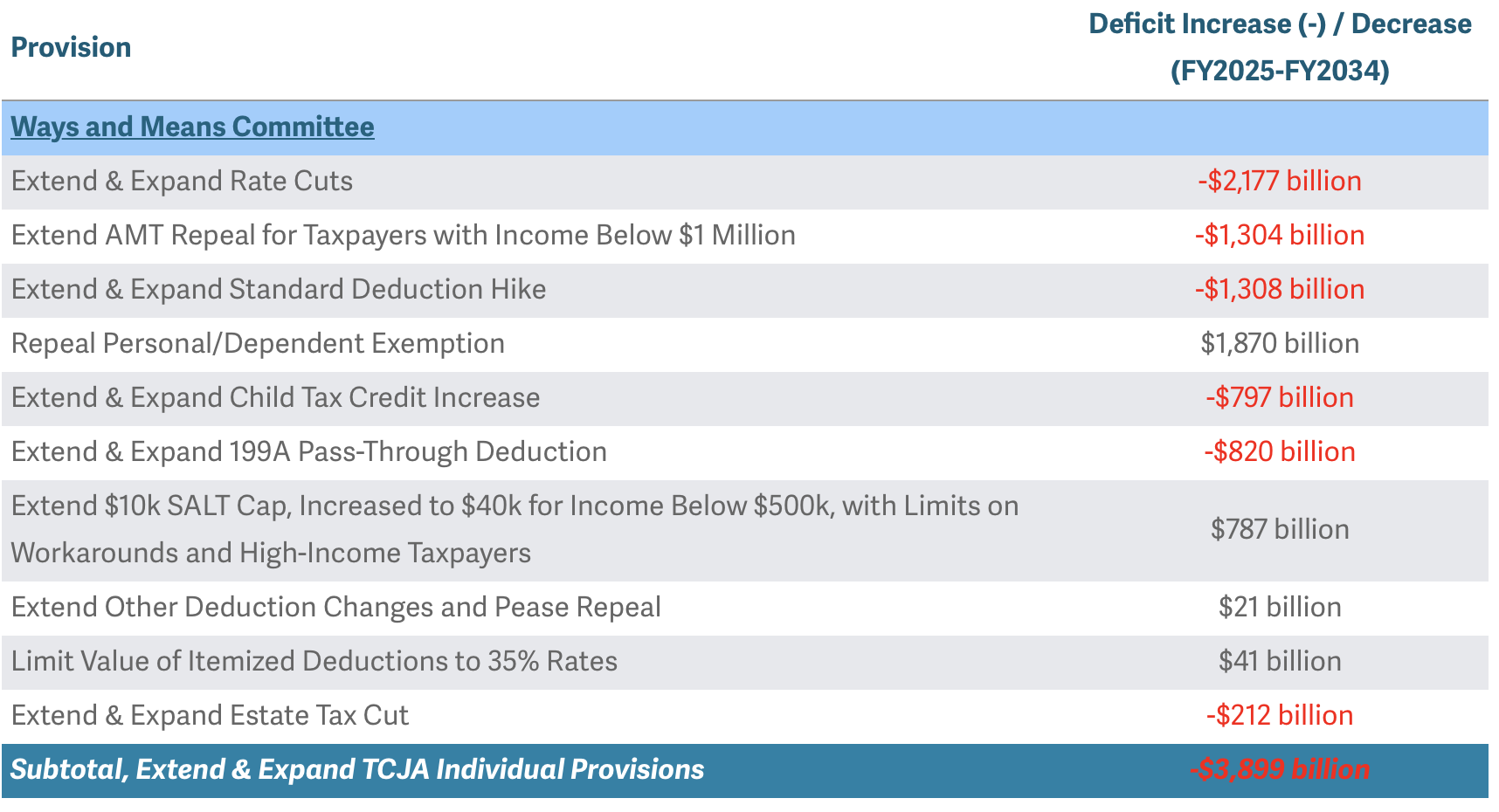
I'm not sure why the SALT (State and Local Tax Deduction) item shows that increasing the cap to $40,000 for incomes below $500,000 from the current $10,000 cap would result in a ten year deficit reduction of $787 billion. I'd assumed that raising the cap would increase the deficit by reducing federal revenues. But maybe the reason is the mention of "limits on workarounds and high-income taxpayers," in line with a CNBC story.