

If the efforts of city councilor Vanessa Nordyke to make a mobile crisis unit a reality in Salem ever come to fruition, she deserves a Perseverance Prize.
Because while the general public really likes the idea of having people other than police officers respond to mental health and other calls that don't require an officer, the Salem Police Department, City Manager, and her fellow city councilors haven't been nearly as enthusiastic.
Last Monday the City Council dealt the mobile crisis unit proposal another setback when Nordyke's motion to seek $2 million in state funding for a multi-year pilot project failed to pass on a 4-4 vote. (Councilor Phillips was absent, leaving eight of the nine councilors present.)
As reported by the Salem Reporter, those supporting the motion were Nordyke, Jackie Leung, Jose Gonzalez, and Linda Nishioka. Opponents of the motion were Chris Hoy, Micki Varney, Virginia Stapleton and Mayor Chuck Bennett.
It's disappointing that Nordyke didn't have the support of progressives Hoy, Varney, and Stapleton. This was an opportunity for them to take a concrete step toward funding a mobile crisis unit. Instead, only a lackluster motion passed.
Salem city councilors on Monday unanimously voted to seek funding sources for a mobile crisis response team that could respond to some 911 calls instead of police.
But councilors narrowly voted against putting funding for such a project in the city’s list of priorities for the 2023 legislative session.
Only $700,000 is needed to fund a mobile crisis unit for a year. The 2022-23 budget for the Salem Police Department is $54,491,000. So $700,000 is a mere 1.3% of the police department budget. In Eugene, use of the widely acclaimed CAHOOTS mobile crisis response team answered 17% of the Eugene Police Department's call volume.
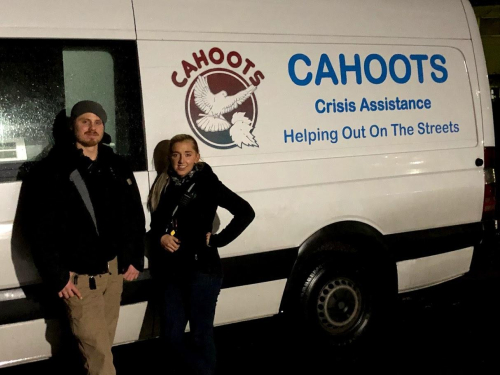
As I noted in "Police budget should be cut to pay for crisis response team," the CAHOOTS program more than pays for itself.
In 2017, the most recent year shown on the White Bird Clinic web page, CAHOOTS teams answered 17% of the Eugene Police Department's call volume. Yes, 17%.
That's a big savings, given the much lower cost of CAHOOTS staff compared to police officers. This chart shows that in 2017 CAHOOTS diversions saved the Eugene Police Department $12 million, with the department budget being $51.3 million in that year.
…Eugene is about the same size as Salem. The CAHOOTS budget is about $2.1 million a year.
So it sure seems like one way to pay for a CAHOOTS-style crisis response team here would be to take a couple of million dollars from the Salem Police Department budget.
Even if the initial savings from a Salem crisis response team was only 1/6 of the savings Eugene had in 2017, a Salem CAHOOTS costing $2 million a year would pay for itself.
Thus the search for funding sources to pay for a mobile crisis response team in Salem should start close to home: in the police department budget. It's extremely likely that somewhere in the $54,491,000 budget there's at least $700,000 to get a one-year pilot project underway.
Instead, it looks like city officials are going to embark on a quest for grants, donations, and the like. Better than nothing, but way worse than funding a mobile crisis unit out of savings from 911 calls that police officers don't have to respond to.
Why isn't this being done?
Probably because Police Chief Womack wants to continue expanding the department, and a mobile crisis unit threatens his bureaucratic fiefdom. Sadly, half of the City Council is fine with this, leaving people in Salem unable to benefit from having trained mental health workers respond to many 911 calls.
Councilor Nordyke shared her take on the City Council's action in a Facebook post.
Discover more from Salem Political Snark
Subscribe to get the latest posts sent to your email.
I recommend review of the 9/23 Legislative Committee meeting discussion of Legislative priorities to provide context for this post. MCU discussion is approximately 14:20-18:00 No members of the public provided public comment.
https://youtu.be/Wa17nG6HXIQ
The claimed CAHOOTS 17% call diversion rate is wildly inaccurate. An analysis based on data from January 1, 2019 through December, 31, 2019 found that the actual diversion rate is closer to 5% to 8%:
https://www.eugene-or.gov/DocumentCenter/View/56717/CAHOOTS-Program-Analysis#:~:text=ALL%20CAHOOTS%20ARRIVED%20CFS%3A&text=It%20is%20often%20caused%20by,is%20no%20longer%20on%20scene.